

Brazil Real Estate Investor Visa: Residency Through Property Investment

Your property purchase and Brazilian residency, coordinated by one legal team. Oliveira Lawyers assists foreign buyers seeking long-term residency through qualifying property investment, commonly called the Brazil Golden Visa or real estate investor visa. We coordinate the property acquisition and residency application, from reviewing a proposed purchase to preparing the immigration application. Our bilingual full-service firm is led by Luciano Oliveira, an attorney licensed in Brazil, Texas, and California.
Our selective approach. We focus on full representation for clients who value their time, want candid advice, and prefer an established international law firm to manage the legal work. Oliveira Lawyers was built from the ground up to help foreign citizens like you succeed in Brazil. Learn more about our firm and approach.
Reviewed by Luciano Oliveira — Brazil–US attorney, LL.M., licensed in Brazil, Texas, and California · Last reviewed: July 2026.
This page is general information, not legal advice. Your situation is unique and should be reviewed by a licensed Brazilian attorney for advice specific to your circumstances.
Why Foreign Citizens Trust Oliveira Lawyers
- Judgment and experience that matter. We review the property, seller, and investment records before you commit. Purchase terms and evidence of funds transferred from abroad receive attention alongside your residency plans.
- An attorney responsible for your case, with progress you can follow. Our attorneys and team coordinate preparation, submission, and responses to immigration authorities. Your online board shows documents and the next steps.
- Staffed offices in Brazil, with support abroad. Our Brazilian offices provide local support, while our U.S. offices coordinate documents such as background checks, birth certificates, and apostilles, reducing the work you have to coordinate across countries.
- Support at your Federal Police appointment. We schedule your appointment and prepare the personal and investment records needed for your case. Professional accompaniment is available in all major Brazilian cities.
- A relationship that makes the next step easier. After your purchase, rely on a firm familiar with your investment for tax matters, estate planning, and future property transactions as your life in Brazil develops.
Experience you can verify when hiring us. Our firm has received hundreds of Google reviews. Read selected client experiences with property investment and residency, and watch our Brazil Golden Visa video.
Start with an online consultation to discuss your proposed purchase, residency plans, and the legal support your investment needs.
Real estate investor visa at a glance
| Minimum investment | R$1,000,000; R$700,000 in the North and Northeast. Qualifying urban properties may be combined. |
|---|---|
| Eligible property | Completed or under construction, with different required documents. Possession-only and rural property do not qualify. |
| Money from abroad | Your own foreign-source funds, with the required evidence of the international transfer and property investment. |
| Initial residency | Four years. A later application for indefinite residency requires maintaining the investment and meeting the other conditions. |
| Time in Brazil | At least 14 days during each two-year period after Federal Police registration. Citizenship requires a different residence assessment. |
| Family and citizenship | Eligible relatives may apply under family-reunion rules. Property investment gives a route to residency, not an automatic passport. |
Plan before purchasing. The property, ownership structure and money-transfer evidence need to support the residency application. A purchase alone does not guarantee approval.
Sources: RN 36, particularly articles 2–6-C · Citizenship residence requirements
Understanding the Brazil Golden Visa
Brazil has one of the top 10 largest economies, an unmatched level of happiness among its residents, and is simply the most beautiful country in the world. For those reasons and plenty of others, you might be interested in immigrating to Brazil. But you need to have a legal right to reside in the country for an extended period of time before you can do that.
One way to get that right is by investing in Brazilian real estate. The Brazil investor visa known as the “Golden Visa” makes you eligible for long-term residency in Brazil — and, four years later, to residency for an indefinite period (what Brazilian law calls prazo indeterminado) and eventually citizenship. Learn more about the immigration requirements, which are covered below.
Current as of July 2026 — thresholds and timelines checked against RN 36/2018 as amended (RN 46/2021, RN 49/2024).
How can we help with your property investment and residency plans?
Have legal questions?
Discuss your property investment, residency plans, and possible next steps in an expert consultation with Luciano Oliveira.
Consultation fee credited in full toward our professional fees when you hire us.
A professional-fee estimate?
Tell us briefly about your property plans and the assistance you need. We’ll review your inquiry to prepare an estimate of our professional fees.
For substantive legal questions, please choose a consultation.
One legal plan for the purchase and residency application
Our real-estate and immigration work connects the transaction to the evidence needed for an investor-residency application. The engagement can include:
- Before purchase: review the proposed property, ownership structure, and intended investment against the residency route; identify legal and document issues before signing.
- During the transaction: property and seller due diligence, contract review, coordination of funds-transfer documentation, and closing support within the agreed scope.
- For residency: organize the qualifying investment evidence and personal documents, prepare the application, and assist with the agreed registration steps.
You can begin from abroad with an online consultation in English or Portuguese. Remote preparation or a property closing by power of attorney does not remove personal attendance requirements in the immigration process. Purchase support, immigration work, and any separate tax advice should be expressly scoped.
The official real-estate investment rules govern this route. Investment in a company follows a different residency pathway. Read about our real-estate legal services and this guide’s reviewer, Luciano Oliveira.
One Program, Many Labels
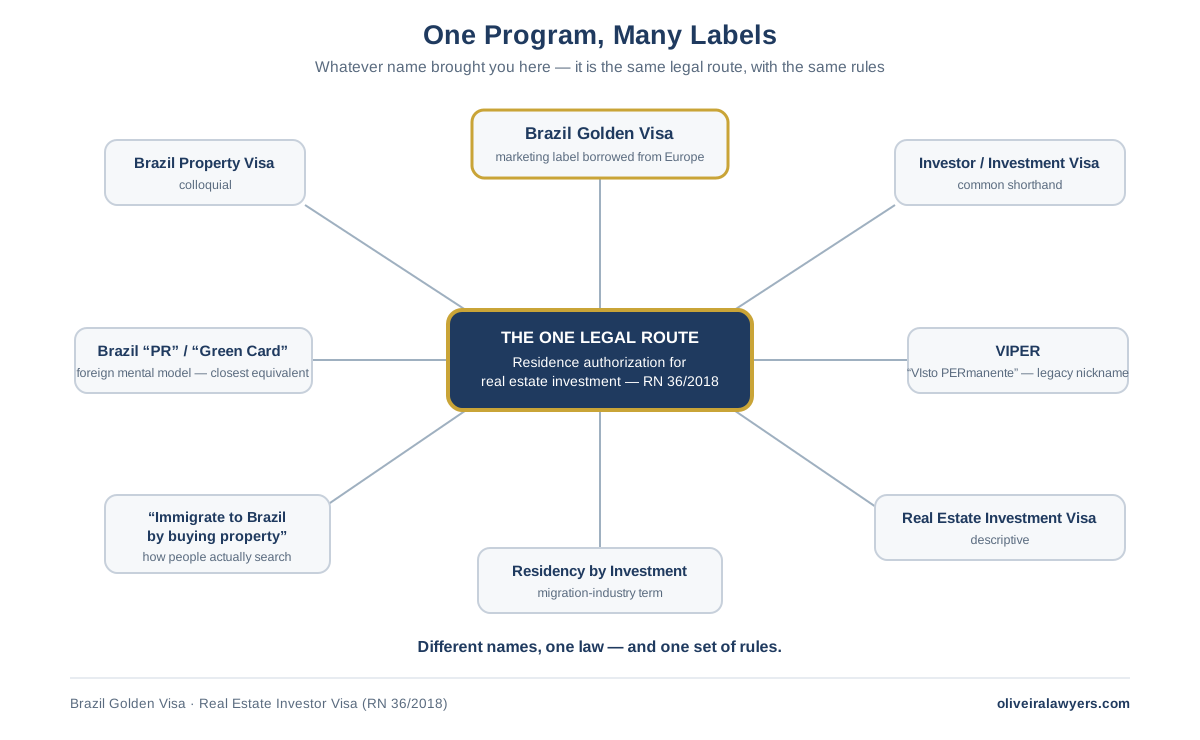
If you’ve been researching how to obtain Brazilian residency by purchasing property, you’ve likely come across various terms that might cause confusion. Labels such as Brazil Real Estate Investment Visa, Residency in Brazil through Real Estate, Brazil Investor Visa, Permanent Visa Brazil by Property Investment, Brazil Real Estate Residency Program, Brazil Property Visa, or simply Buy Real Estate in Brazil for Residency all refer to the same legal path to residency. Despite the differing names — some official, some colloquial — the ultimate goal is identical: acquire qualifying real estate in Brazil and secure a residence permit as outlined by Brazilian immigration authorities.
The Brazilian government frames this option as a residence authorization for real estate investment under Normative Resolution 36/2018 (RN-36); the popular nickname “VIPER” (Visto Permanente) stuck from the previous legal regime. In marketing and general conversation, service providers adopt recognizable labels like Brazil Golden Visa to echo popular programs in other countries. Meanwhile, everyday phrases such as Immigrate to Brazil by Buying Property capture how people typically search for this opportunity.
One more translation that helps many of our clients: what Americans call a “green card” and what Indians, Canadians, and Australians call “PR” (permanent residency) corresponds, in Brazil, to the residence authorization this page describes — first granted for four years, then converted to indefinite duration. There is no literal “Brazil green card” or “Brazil PR visa,” but this investor route is the closest equivalent, and it is open to applicants of any nationality.
Selected five-star client reviews
Golden Visa, property purchases, and residency support · Excerpts from public Google reviews.
Arjen Vons
Dec 29, 2024 · Google
★★★★★
Golden Visa and property purchase
“During the second part of the process, we were supported by Atlas Nascimento and Patrick Moreth, who made sure we provided all required documents and certificates that are required for the visa application. They also provided status updates all the time and answered any questions we had.”
Ahmed Ayyad
30 weeks ago (recorded October 1, 2026) · Google
★★★★★
Property purchase and residency
“Navigating a real estate purchase and residency process in Brazil from abroad can be incredibly daunting, but the team—specifically Camila, Paulo, Marina, and of course Mr. Oliveira himself made the entire journey seamless and secure.”
Brian Holland
5 weeks ago (recorded October 1, 2026) · Google
★★★★★
Property purchase for longer-term residence
“Paulo, Geórgia, and the rest of team carefully and diligently guided me through the process of purchasing a home for the purpose of securing longer-term residency. They were available to answer questions and help navigate complexities every step of the way.”
Michael Gibson
Mar 26, 2025 · Google
★★★★★
Property purchase for an investment visa
“This is a review for Paulo, marina, and atlas, all of which were a part of a team that helped me buy a house for investment visa status in brasil. They are great, professional, good communication, diligent, and competent at answering questions. I would highly recommend them”
Read 4 more client reviews
Jason Gant
Jul 14, 2023 · Google
★★★★★
Investment residence and property purchase
“Luciano and his team were very helpful and trustworthy throughout the entire process of assisting me in getting my Residency by Investment visa as well as my real estate property purchase in Brazil. I highly recommend Luciano. He is knowledgeable and provided fantastic suggestions and support.”
Zhongyuan Zhao
Sep 17, 2024 · Google
★★★★★
Property and immigration support
“Buying real estate in Brazil and navigating the immigration system is complicated and nuanced, and it is especially challenging for foreigners who do not master the Portuguese language.”
Yosuke Matsuda
34 weeks ago (recorded October 1, 2026) · Google
★★★★★
Property purchase and residence
“I used this firm for my property purchase and to help secure my residence, and they were fantastic. Everyone I dealt with was super nice, from the lawyers and agents to the office staff. They answered my questions right away, and the whole process was smooth.”
Dont Tread On Me
May 21, 2024 · Google
★★★★★
Residency and property representation
“Top Notch Service – Professional, knowledgable, concise and fluent in English. A while back I tried getting a residency and purchasing property WITHOUT an Attorney in Brazil – never again. Oliveira is my new "Go-To" in Brazil for residency and real estate representation. Obrigada Luciano and Team!”
Selected reviews describe individual experiences, not guaranteed outcomes. Review wording is preserved in these excerpts; use the source links to read each full review.
Brazil’s Real Estate Golden Visa: An Overview

The goal of Brazil’s golden visa program is to attract foreign dollars into the economy. It is residency by investment in its most straightforward form: one qualifying purchase, one application. To that end, the country requires interested parties to use external resources to invest in a property that costs at least R$1,000,000.00 — roughly US$180,000–200,000, depending on the exchange rate, as of the time of writing.
Is it really “permanent” from day one?
Not on day one. The initial residence authorization under RN-36 is granted for four years. If you still own the qualifying property at the end of that period, you may apply to convert it into residency for an indefinite period (prazo indeterminado — the closest thing Brazilian immigration law has to “permanent”). The citizenship math that follows is covered in the citizenship-path section below.
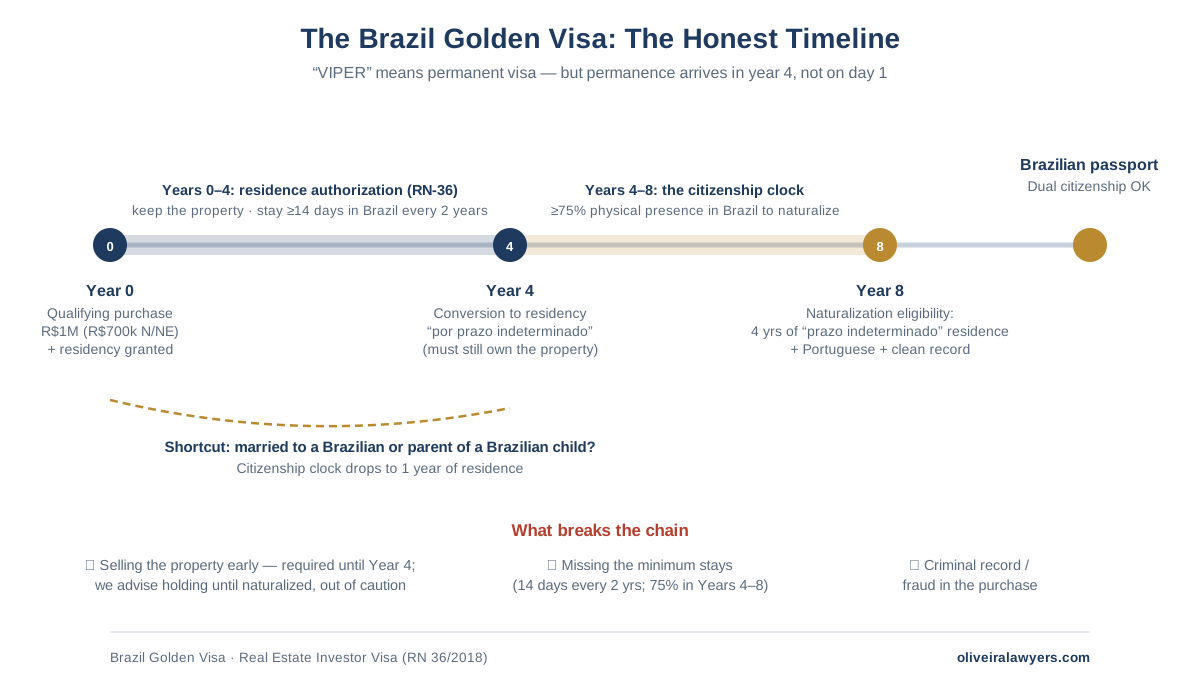
So the realistic arc is: invest → four-year residence authorization → indefinite residency → citizenship eligibility. Neither the change to indefinite residency nor naturalization is automatic; each requires an application and compliance with the applicable rules.
Here are a few key things to know about this investor visa program known as VIPER:
- The property must be located in an urban area.
- You can qualify by purchasing two or more properties that cost at least R$1,000,000.00 together.
- Co-ownership is allowed as long as each co-owner invests the minimum amount.
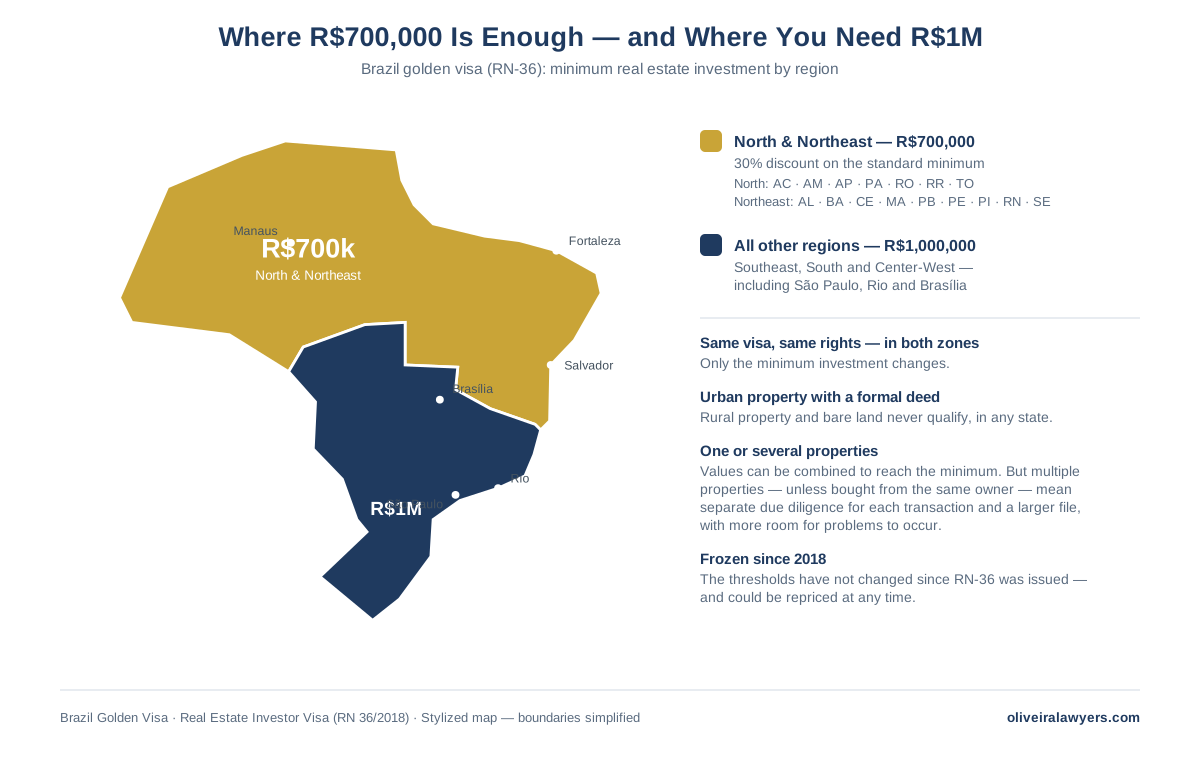
- You can spend up to 30% less on the property and still qualify if you purchase in certain areas of the country: the North and Northeast, where the threshold is R$700,000.
Residency in Brazil through real estate?
Or write to [email protected]
What Has to Qualify: the Property, the Seller, the Money, and You
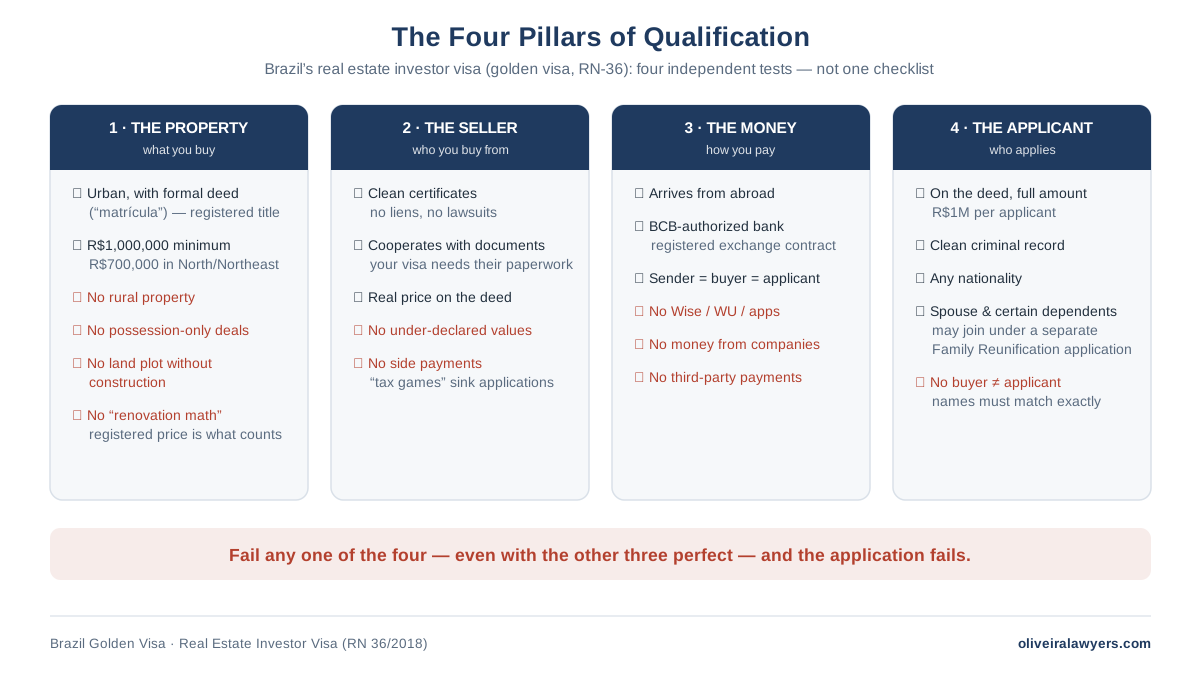
Most guides treat eligibility as one checklist. In our practice, applications live or die on four independent fronts — and a failure on any one of them sinks the residency application even if the other three are perfect.
1. The Property
For a completed property, the property registry record (matrícula) must show the investor’s ownership and satisfy the requirements of RN 36. The Public Deed (Escritura) and the matrícula are different documents: signing the Deed alone does not transfer ownership; registration does. Possession-only properties do not qualify. Rural properties do not qualify — note that even an apartment built in a neighborhood classified as rural will not qualify. The minimum is R$1,000,000 in urban property (R$700,000 in the North and Northeast), reachable with one property or several that add up. Properties under construction follow a separate document checklist under RN 36; see the off-plan FAQ below. The registered transaction and evidence of the qualifying investment must match — which is why the pricing games discussed below are dangerous.
2. The Seller
Your seller is, in practice, part of your application. The purchase must survive due diligence on the seller’s side — negative certificates, no liens, no lawsuits that could attack the sale — and the seller must cooperate with documentation that proves a clean, real transaction at a real price. A seller who refuses to provide personal documents, insists on under-declaring the price “to save taxes,” or wants side payments off the deed is not a quirky negotiator: they are a threat to your residency. See “Challenges Nobody Warns You About” below for how this plays out in Rio de Janeiro specifically.
3. The Money — Why Wise, Western Union and MoneyGram Can Sink Your Application
Sending the payment to a party other than the seller or having the funds earmarked by the bank for a purpose other than real estate purchase may disqualify your purchase and preclude you from obtaining the residency. Currency exchange houses, boutiques, or smaller operators usually cannot provide the contract paperwork required by Brazilian immigration. Work only with formal banks located in Brazil and authorized by the Brazilian Central Bank to handle currency exchange.
Three rules of thumb our team repeats daily: the funds must come from abroad; they must arrive through a registered exchange contract naming you; and the sender, the buyer on the deed, and the visa applicant must be the same person. Money sent by a relative, a company, or a friend — however innocent — breaks the chain the immigration authority needs to see. For the full picture, see our guide on how to send money to Brazil.
One rule we never bend: purchase funds move only through FX banks regulated by the Central Bank of Brazil — the mechanics are covered in our closing-funds service.
4. The Applicant
The applicant must appear on the deed as the buyer of the qualifying amount. A couple buying together qualifies one applicant per R$1,000,000 invested — see the denial examples below. The applicant must also have a clean criminal record and may include spouse and dependents in the application. There is no nationality restriction: our recent applicants include clients from the United States, Canada, the UK, India, Egypt, Pakistan, the Gulf, and West Africa. Applicants from countries whose citizens need a visa even to visit Brazil have a special route, covered in the challenges section below.
How Buying Property in Brazil Is Different From What You Know

Most failed applications trace back to a single assumption: that buying property in Brazil works like buying property at home. It does not. The differences below are not curiosities — each one changes how you must structure a purchase that will support a residency application.
- There is typically no escrow. No neutral third party holds your money between contract and closing. Payment flows are negotiated directly — which is why timing the release of funds against the signature of the deed is a craft, not a formality.
- There is no title insurance. In the US, a title company insures you against defects. In Brazil, your protection is the due diligence done before you sign — there is no policy to claim against afterwards.
- Evicção: the property can be legally attacked even after closing. Under Brazilian civil law, a third party with a superior claim — an unpaid creditor of a previous owner, an heir omitted from a probate, or a fraudulent prior sale — can challenge your ownership after you have paid and registered the deed. The doctrine of evicção gives you recourse against the seller, but recourse is a lawsuit, not a refund. The only real protection is investigating the property’s chain of title and the sellers, including previous ones, before buying.
- Other differences that surprise foreign buyers: the deed is executed at a notary office (cartório) and ownership only transfers upon registration at the property registry; the “matrícula” is the property’s biography and must be read, not skimmed; municipal transfer tax (ITBI) and registration costs add several percent; and verbal assurances from realtors have no legal value whatsoever.
7 Steps to Immigrate to Brazil by Buying Property

Getting the Brazilian investor visa (golden visa / VIPER) through real estate investment is our recommended path to secure permanent residency in Brazil as well as Brazilian citizenship. These are the main steps involved:
STEP #1 Find the Property
It begins by finding a property you like in an urban location and ensuring it meets the minimum investment amount, which is R$1,000,000. Properties in the North and Northeast of the country will qualify for just 70% of the R$1,000,000.
STEP #2 Due Diligence
Once you’ve done that, make sure to have your attorney conduct due diligence on the property before committing to it. This should include title of property with registration, negative certificate of real liens, IPTU negative certification, clearance on sellers, and several other documents, which we describe in more detail here. Given evicção, this step protects both your money and your visa.
STEP #3 Purchase
It can be tough and risky to handle all this from another country — especially if you don’t speak Portuguese. You must secure professional help to structure the deal and send the payment properly. Note that the money remittance to Brazil alone may take multiple weeks and a lot of paperwork.
STEP #4 Residency Application
After you’ve made the purchase, you’ll need to submit the proof of purchase and proof that funds were transferred into the seller’s bank account through a Brazilian bank, along with many other documents. Your attorney will file the so-called VIPER application through MigranteWeb, the system developed by the Brazilian authorities.
STEP #5 Residency Granted
When the validation is complete, you will receive a four-year residence permit.
STEP #6 Upgrade to Permanent Residency
If you’re still the owner of the property after four years, then you may apply to become a permanent resident — residency por prazo indeterminado.
STEP #7 Citizenship
Naturalization is the last step, and this is where honest math matters. In current practice, the four-year residence clock for ordinary naturalization is counted from the date your residency becomes prazo indeterminado, not from the day the first authorization was granted — so plan on applying around year eight. The clock also requires genuinely living in Brazil, not the minimal presence that keeps the permit alive. Married to a Brazilian or parent of a Brazilian child? The residence requirement drops to one year.
Brazil Citizenship by Investment: How Long It Really Takes

| Stage | What it is | Realistic duration |
|---|---|---|
| Investor residency granted | Temporary authorization, renewable | Issued after approval |
| Temporary to indefinite term | Upgrade to prazo indeterminado | About four years |
| Naturalization clock | Only starts at the indefinite-term upgrade, and requires genuinely living in Brazil | About four more years |
| Apply for citizenship | Around year eight |
These are planning periods, not approval deadlines. The Ministry of Justice counts ordinary naturalization residence from residence for an indefinite term. Other requirements and any applicable reduction must be assessed separately. Official guidance.
You will find shorter numbers on marketing sites. Some quote three years, some four, some describe the visa as permanent from day one. The arithmetic above is what we see in practice.
There is no direct “Brazil citizenship by investment” program — no country-of-Brazil passport for sale. What Brazil offers is better for most serious applicants: residency by investment that matures into citizenship.
There can be a faster lane. Buying the real estate through a company under the company-investment route can shorten the path substantially, because that residency runs on an indefinite term from day one under the current rules. We arrange it when it fits, and we tell you what it demands in practice: your immigration status rides on that business, the authorities monitor it as an ongoing operation, and it must sustain verifiable employment or income. If the business fails, you lose the time you were trying to save, and the status that rode on it. If citizenship speed is your priority, say so at the first consultation.
The sequence: qualifying purchase → residence authorization (four years) → residency for an indefinite period → naturalization. The requirements when you apply: (1) civil capacity, (2) four years of residence counted from the indefinite-term upgrade, (3) the ability to communicate in Portuguese, and (4) no criminal conviction, or rehabilitation under the law.
Married to a Brazilian or parent of a Brazilian child? The residence requirement drops to one year — the “Brazil citizenship in 1 year” you may have seen mentioned online, which is real but belongs to the family route, not the investment route.
Brazil allows dual citizenship — you are not required to renounce your original nationality when naturalizing, although you should check your own country’s rules. For applicants from countries with weaker passports, the math is compelling: the Brazilian passport offers visa-free or visa-on-arrival access to much of the world, and Brazil does not discriminate by nationality anywhere in RN-36. That combination is one reason the “citizenship by investment” label, inaccurate as it is, refuses to die.
The Top 3 Mistakes Brazil Golden Visa Applicants Make

1. Seeking help only after buying the property.
The most expensive mistake in this program is quiet and common: buying the property on your own, then coming back to apply. The application is not a formality stapled to a purchase. To give yourself the highest realistic chance of approval, the entire transaction has to run with the visa in mind from day one, and day one is earlier than most people think: it starts before the transaction does, while you are still shopping, because the property, the seller, the money route and the paperwork all have to qualify. Some properties, rural ones for example, can never carry this visa no matter how good the deal looks. This is also why packaged golden-visa services that pick up your case after the purchase are solving the wrong half of the problem. An attorney hired after the purchase can only work with what exists; an attorney hired before the purchase makes sure what exists is approvable.
2. Taking realtors’ “common practices” at face value.
Realtors close sales; they do not defend visa applications. Practices a realtor will describe as normal — paying part of the price to a third party, splitting the commission inside the purchase price, paperwork where the buyer does not match the applicant, money sent by someone else “because it was easier,” or a declared price that does not match reality — are each enough to sink the application. If a shortcut is presented as “how everyone does it here,” treat that as a red flag, not a reassurance.
3. Creative thinking.
Every month we hear inventive plans: “I’ll buy at R$800,000 and spend R$300,000 on renovations — that totals over a million.” “I’ll buy land and build the house myself.” “The off-plan developer promised they’d give me the paperwork for the visa.” None of these work as imagined. The qualifying number is the registered acquisition value of urban, deeded real estate — not your total spend, not construction costs, not a developer’s assurances. Off-plan purchases can qualify in specific configurations, but only when the documentation is structured for it from the start, not retrofitted afterward.
Brazil Golden Visa: the Challenges Nobody Warns You About

Sellers who won’t share documents — especially in Rio.
In Rio de Janeiro’s coastal neighborhoods — a seller’s market for the price brackets this visa targets — many sellers simply refuse to provide the personal documentation a clean exchange and a defensible application require, especially on lower-priced properties. Some are protective of their tax exposure; some play games with declared values; some just won’t bother when another buyer is waiting who asks no questions. Finding a property is easy; finding a property with a cooperative, documentable seller is the actual search.
After the purchase, fixes may not solve the problem
The immigration authority analyzes the transaction you completed — not the transaction you wish you had completed, and not how you plan to fix it later. Do not assume that amending a Deed, changing the buyer, or obtaining documents later will repair a problem with the qualifying investment. Some document errors may be correctable; others may prevent the purchase from supporting residency. Have your attorney assess the actual records before attempting a fix.
The R$1,000,000 minimum is a political variable.
The threshold has not changed since RN-36 was issued in 2018 — eight years of inflation have quietly made the program cheaper in real terms every year. That cuts both ways: it is an opportunity today, and it could be repriced by a simple resolution at any time, with no grandfathering guaranteed for purchases not yet completed. Buyers who are “almost ready” for years are betting against that clock.
One more thing the brochures skip. Yes, the threshold drops in the North and Northeast regions, and Northeast cases are common in our practice. But the lower threshold does not mean a lower-effort process: in less-developed markets the property paperwork is often harder, with older records and slower registries. The discount is real; so is the extra diligence it demands. Budget for both.
Some applicants can’t even visit Brazil first.
Citizens of India, Egypt, Pakistan, and several other countries need a visa just to set foot in Brazil. For these clients we structure the entire purchase remotely — power of attorney, remote due diligence, exchange contract from abroad — and then apply for the autorização prévia de residência (prior residence authorization), with the final visa step completed at the Brazilian consulate in the applicant’s country of origin. It is a well-trodden path in our practice, but it must be planned as such from day one.
What Does the Brazil Golden Visa Cost, All In?
Beyond the investment itself (R$1,000,000, or R$700,000 in the North/Northeast), budget for municipal transfer tax (ITBI) and registry costs, typically 3–5% of the property value combined, varying by city; due diligence and closing legal work; sworn translations and apostilles of your personal documents; government application fees, which are modest; and professional fees for the visa application. Law-firm pricing models vary widely — see the FAQ on fees below. The investment must arrive from abroad through a registered exchange operation; the costs of getting that wrong are not measured in fees but in denied applications.
Brazil vs Portugal, Paraguay and the UAE: How the Programmes Compare
Almost nobody looks at Brazil in isolation. The comparison that matters is not which programme is cheapest, but which ones still allow you to qualify by buying property at all — because several of the best-known ones no longer do.
| Programme | Real-estate route | Minimum investment | Route to citizenship |
|---|---|---|---|
| Brazil | Open | R$1,000,000 — R$700,000 in the North and Northeast | Around year eight (see the timeline above) |
| Portugal | Closed since October 2023 | €500,000 through qualifying funds | 10 years for most non-EU applicants under the 2026 nationality reform |
| Paraguay | Open | US$200,000 under the Investor Pass real-estate route | 3 years of residency |
| United Arab Emirates | Open | AED 2,000,000 | No ordinary route to citizenship |
Figures verified July 2026. These programmes change often, and two of these are recent: Paraguay opened its Investor Pass route in April 2026, and Portugal’s citizenship timeline changed under its 2026 nationality reform. Confirm the current position before committing to any of them — including ours.
Brazil Real Estate Investment Visa Benefits

Benefit #1 Brazilian ID card for foreigners
The CRNM is a Brazilian ID card exclusive to foreign citizens residing in Brazil. This card will allow foreign citizens to open a bank account, apply for a driver’s license, and many other benefits.
Benefit #2 Staying in Brazil for as long as you want
Most foreign citizens can stay only for up to 180 days in Brazil.
Benefit #3 Entering and leaving the country as many times as needed
As a resident, there is no limit to how many times you can enter and leave the country.
Benefit #4 Access to utilities and other services
Many utility companies and service providers will not provide service unless you have a Brazilian ID. The CRNM is virtually accepted by all utility companies and service providers.
Benefit #5 Access to Brazil Citizenship
Last but not least, the Brazil Viper visa allows you to apply for Brazilian citizenship. While there is no direct Brazil citizenship by investment program, residency matures into eligibility: in current practice the four-year naturalization clock counts from your upgrade to residency for an indefinite period — about year eight of the journey for most investors.
A word on who is answering. Oliveira Lawyers has run foreign-buyer transactions since 2004 and carries 400+ five-star Google reviews across 7 offices. The firm appears on the legal-assistance directories of the US embassy and of Brazilian consulates, holds OAB Brasil, OAB São Paulo, OAB Rio de Janeiro and OAB Brasília registrations, and its managing partner is admitted in California, Texas and select US federal courts, with memberships in the International Bar Association and the American Bar Association’s International Law Section. The team of 17 replies by the next business day.
“Patrick, Luciano and team made renewing my visa easy and stress free!”
— client review, Rio de Janeiro office · read our Google reviews
And because this visa is a property purchase at its core: see what our full purchase support covers, step by step.
The legal basis
The program rests on CNIg Normative Resolution 36/2018, as amended by RN 46/2021 and RN 49/2024. The amendments adjusted the investment-declaration mechanics under the current FX framework (Lei 14.286/2021) and, for the separate company-investment routes (RN 11/2017 and RN 13/2017), made that residency indefinite from day one. Full texts are on the Ministry of Justice’s immigration portal; what they mean in practice is what this page explains.
| Source | What it supports |
|---|---|
| RN 36 and amendments | Investment thresholds; completed and under-construction property; financing; four-year authorization; continued investment; 14 days per two years; loss of the basis for residency. Articles 2–6-C. |
| Brazilian consular guidance on VITEM IX | Consular guidance includes qualifying real-estate investment under VITEM IX. The government site may display a browser-verification screen. |
| Ministry of Justice naturalization guidance | Ordinary naturalization residence period is counted from residence for an indefinite term. |
| Migration Law 13445 of 2017 | Naturalization requirements, including criminal conviction or rehabilitation. Articles 65–66. |
| Brazilian Civil Code | Ownership transfers through registration of the transfer instrument. Article 1245. |
Getting Started

If you think that the country’s investor visa program through real estate investment is right for your family, then there’s no time like the present to begin this process. That’s why Oliveira Lawyers offers easy-to-schedule live paid consultations with Brazilian immigration attorneys by Skype, Zoom, or WhatsApp to discuss your goal of securing residency by investment in Brazil. You can pick whatever time works for you and sign up here.
Immigrate to Brazil by buying property?
Or write to [email protected]
Frequently Asked Questions About Brazil Golden Visa (VIPER)

1. Can you finance your purchase?
Unfortunately, you can’t finance your entire purchase and qualify for the investor visa. The minimum foreign direct investment is R$1,000,000 (R$700,000 in the North and Northeast), meaning this money must come from abroad. But you can finance any amount over such minimum. For example, if you wanted a property that costs R$2,000,000.00, you could finance a maximum of R$1,000,000.00 of the purchase and still qualify. Finance is also rarely extended to those who are not currently legal residents in Brazil. Thus, being a cash buyer is almost always a must.
2. Can your family members come with you?
Yes. Brazil allows you to bring your family with you as long as you qualify for the investment visa individually. This includes your spouse and any dependents that you have, usually children but sometimes other dependents as well.
3. Do you need to live in Brazil full-time?
No. RN 36 requires the property investor to spend at least 14 days in Brazil, together or spread across visits, during each two-year period counted from Federal Police registration. That is different from living in Brazil long enough to qualify for citizenship. Plan your registration and travel with your attorney. Applicants who cannot visit Brazil before applying should read the autorização prévia de residência explanation above: prior authorization and the consular visa can be arranged from abroad, but they do not remove the later registration and stay requirements.
4. How does Brazil’s Golden Visa compare to other countries?
Brazil’s real-estate route is open — and in several of the best-known programmes, it no longer is. Spain abolished its golden visa outright in April 2025. Portugal, the programme that made “golden visa” a household phrase, removed its real-estate route in October 2023, and its 2026 nationality reform lengthened the wait for citizenship for most non-EU applicants. Greece still allows property investment, but now prices it by zone, with the steepest thresholds in Athens, Thessaloniki and the busier islands. Brazil’s door remains open at a fraction of European price points.

5. What about permanent residency in Brazil by investment in business?
Permanent residency through real estate property purchase in Brazil is much better than residency through business acquisition for many applicants. The business acquisition route involves many requirements regarding the type of business you buy, how you buy this business, and how you recruit and maintain employees, among other things. By purchasing real estate, on the other hand, you can secure residency in Brazil through a more straightforward route.
6. What if I want to both live and run a business in Brazil?
Our advice is that you first secure residency through real estate acquisition and then start your business in Brazil like everyone else without a thousand strings attached.
7. What are some of the issues why investor visa applications in Brazil are denied?
Some examples: foreign investment money is brought by non-official banks, such as money-transfer apps; the money must be transferred into Brazil by a bank registered with the Brazilian Central Bank. A property is purchased for R$1,000,000, but the deed is recorded with the property being purchased by a couple; R$1,000,000 secures the residency of a single person. A property is purchased for R$1,000,000, but the purchase contract says part of the selling price is being paid as real estate commission to the realtors. The persons in charge of handling your application do not reply timely or fail to provide the required documents. These are exactly the realtor “common practices” discussed in the Top 3 Mistakes section.
8. Can I handle my investor visa application myself?
You should not attempt to handle your application yourself. The application website, the so-called MigranteWeb, is cumbersome and difficult to understand even by Brazilian immigration attorneys. After spending R$1,000,000, you don’t want to risk your residency by trying to handle this process yourself.
9. Can I hire an attorney after I purchase my property?
Yes, you can. But we strongly recommend that you retain an attorney even before selecting the desired property. Many issues that could impact your application will show up during the selection and acquisition of your target property: a property without a legal title would not qualify; a contract that indicates part of the purchasing price as real estate commission will cause a denial; sending the funds through secondary exchange channels such as Wise, Western Union, or MoneyGram may result in denial, because the financial entity handling the currency exchange must issue a formal letter confirming the funds came from abroad, and these channels will rarely issue such declarations. Remember: after Closing, fixing the paperwork may not fix the qualifying investment.
10. How does the Brazil Golden Visa relate to VITEM IX?
VITEM IX is a temporary visa category used for investment, including qualifying real-estate investment. It is not limited to investment in a Brazilian company. The important distinction is the rule supporting the application: RN 36 covers property investment, while RN 13 covers investment by an individual in a Brazilian company. These routes have different requirements. Your attorney should identify the right route and whether your case needs prior residence authorization and a consular visa.
Source: Brazilian consular guidance on VITEM IX
Brazil real estate investment visa?
Or write to [email protected]
11. Is the Brazil Golden Visa the best way possible to immigrate to Brazil?
Different people will have different paths toward a legal resident status in Brazil. Some people will marry to secure residency in Brazil. Other people will qualify to work as sponsored employees. One thing is for sure: as long as you have the funds to purchase a property in Brazil, an investor visa based on real estate acquisition is one of the fastest and easiest paths to secure residency and, later on, citizenship. If you want to “try Brazil out” for a couple of years first, consider the Brazil Digital Nomad Visa.
12. How long do I need to hold the property? How soon can I sell?
For a completed property, the application requires the property registry record showing your ownership, together with the other required documents. The initial residence authorization is for four years. You may then apply for residency for an indefinite period, provided you maintain the qualifying investment and meet the other requirements. Do not assume that indefinite residency automatically makes it safe to sell: RN 36 also addresses loss of the basis for residency. Have your attorney assess the effect of a proposed sale on your particular status before you commit.
13. How do I convert my residency into full Brazilian citizenship?
A foreign citizen should be able to apply for Brazilian citizenship once the residence requirement is met — in current practice, four years counted from the date your residency becomes indeterminado, which lands around year eight of the overall journey for most investors. The application currently has four requirements: (1) civil capacity; (2) four years of residence counted from the indefinite-term upgrade; (3) ability to communicate in Portuguese; and (4) no criminal conviction, or rehabilitation under the law. Married to a Brazilian or with a Brazilian child? The required residence drops to one year.
14. Is there an English translation of the original rules?
The Brazil Golden Visa is based on Normative Resolution 36 issued by the National Immigration Council on October 9, 2018. You can read the original resolution in Portuguese here and our English translation of Resolution no. 36 here.
15. How much will a law firm charge to assist?
Professional fees range from a couple of thousand dollars to a percentage of your target property value. In the lower range are those who act more like a paralegal — they will mostly just fill out the forms after you have already bought the property. In the upper range are those truly specialized firms that will take you by the hand and handle not only the investor visa application but also the entire process of purchasing your dream property.
16. Can I get Brazil citizenship by investment?
Yes — as long as you do all of the following: make a qualifying real estate investment (R$1,000,000, or R$700,000 in the North/Northeast), structure the purchase and the money trail correctly, obtain the residence authorization, maintain effective residency and ownership through the four-year conversion, learn functional Portuguese, and keep a clean record. There is no shortcut program where a passport is issued against a wire transfer — anyone selling “Brazilian citizenship by investment” as a direct product is misleading you. What Brazil offers is a residency by investment program with one of the world’s shortest and cheapest paths from investment to naturalization.
17. What is the easiest way to obtain Brazil permanent residency?
If you have the means and your end goal is to obtain permanent residency in Brazil, look no further: purchasing real estate is the way to go. There are few rules to follow and few strings attached compared to other residency programs.
18. How to transfer money to Brazil to purchase real estate?
Money transfer to Brazil is more complex than money transfer to other countries. Check our complete content on how to transfer money to Brazil.
19. Where can I find a list of all the documents required?
We have a sample checklist that you can use as a starting point. Important: you should not attempt to handle the application or any part of the process by yourself.
20. Is this the same thing as the Brazil VIPER visa?
Strictly speaking, no — although everyone calls it that, including many professionals. “VIPER” stands for Visto Permanente (permanent visa), a label inherited from the previous legal regime. What the current program grants is a residence authorization under RN 36/2018, valid for four years — which can later be converted into residency por prazo indeterminado (indefinite duration). The nickname promises on day one what the program actually delivers in year four. That said, if you searched for the “Brazil VIPER visa,” this page covers exactly the program you mean.
21. Is the investor visa a Brazilian “green card” or “PR”?
Functionally, yes. Brazil does not use those terms, but the CRNM card plus residency por prazo indeterminado is the Brazilian equivalent of a US green card or Commonwealth PR: live, work, study, enter and leave freely, sponsor family, and naturalize after the qualifying period.
22. Does Brazil allow dual citizenship?
Yes. Brazil permits naturalized citizens to keep their original nationality. Verify your home country’s position on its side. Most of our clients naturalize without giving anything up.
23. I already bought my property — is it too late to apply?
Not necessarily, but everything depends on how the purchase was executed: the deed, the declared price, whose name is on it, and how the money arrived. If those elements happen to be clean, the application can proceed. If not, options narrow dramatically — see the explanation about correcting records after the purchase above. Send us the deed and the exchange documentation and we will give you a straight answer.
24. Do off-plan (na planta) properties qualify?
Only in specific configurations and with documentation structured for the visa from the start. A developer’s verbal promise that “the paperwork will be fine” is one of the classic mistakes — see Top 3 Mistakes, #3, and our off-plan property guide.
Related guides:
- How to Buy Property in Brazil: the 15-Step Guide
- Business Investment Visa in Brazil (the company route)
- Off-Plan Property in Brazil
- Full Legal Support for Buying Property in Brazil
Request an estimate of professional fees
Briefly describe your proposed property purchase, its location, and the purchase or residency assistance you need. Use this form for a fee estimate; choose the consultation above for substantive legal questions.
Send a service inquiry
Tell us what you need. Our team will reply by email about scope and fees.