

Buying Property in Brazil? Full-Service Legal Support
For international buyers who value their time. Dedicated counsel to anticipate risks, navigate complications, and coordinate your purchase through to registered ownership.

The right legal advice can change the terms you accept, when you pay, and which property you buy. Oliveira Lawyers represents international buyers in any city in Brazil, combining that judgment with the entire legal process until registered ownership. Our bilingual real estate team is led by Luciano Oliveira, an attorney licensed in Brazil, Texas, and California.
Our selective approach. We focus on full purchase representation for buyers who want candid advice and prefer to delegate the legal coordination to an established law firm. We agree the scope, responsibilities, and professional fees in writing before you engage us.
Why Clients Trust Oliveira Lawyers
- Independent advice before you commit. We represent you and take no share of the realtor’s commission. Our property, seller, and title checks help you decide whether to proceed, negotiate protections, or walk away.
- Contracts tailored to your purchase. We negotiate payment terms, deadlines, and remedies for default around the due diligence findings, your foreign documents, banking needs, and travel plans.
- Payment coordinated with closing. We coordinate the transfer route, documents, and payment timing with regulated currency-exchange banks and the notary. The bank handles your purchase funds. Our team coordinates the legal steps around their release.
- Support through registered ownership. We coordinate closing, remote arrangements where needed, and deed registration. Your online board and dedicated WhatsApp group keep documents, decisions, and progress visible.
- A firm for your next steps. We consider how you intend to use and own the property. You can also enjoy immigration, tax, and estate work with a firm that already knows the transaction, with additional services agreed separately.
Judgment clients have relied on. One buyer walked away on our advice after a review uncovered major concerns. We later helped him complete two other purchases. Read some of our client reviews to learn how clients describe working with the team.
Start with an online consultation before signing or sending a deposit. Discuss your property, plans, and deadlines in a 40-minute Zoom consultation with Luciano Oliveira.
Reviewed by Luciano Oliveira — Brazil–US attorney, LL.M., licensed in Brazil, Texas, and California · Last reviewed: July 2026.
One caveat before the details: this page is general information, not legal advice. Your purchase, your documents and your dates shape the actual work — that is what the consultation is for.
PERSONAL LEGAL CONSULTATION
Discuss your plans with Luciano Oliveira
40-minute Zoom consultation · US$125
Discuss your planned purchase, property and seller checks, contracts, closing costs, and next steps.
Consultation fee credited in full toward your services.
Why Buying Real Estate in Brazil
If you are reading this page, you probably don’t need to be convinced to buy a property in Brazil. This said, the benefits of owning real estate in Brazil include capital appreciation, rental income, and risk diversification among others.
You probably know that buying real estate in Brazil may also unlock a legal residency in Brazil so you can stay in the country as much as you want and even pursue citizenship in the future. Last but not least, owning property in Brazil also brings social and emotional upsides, not to mention a lifestyle that can color your life, improve your life, and even open the doors to a second life if that’s what you want.
What the Journey of Buying Real Estate Entails

Even a “simple” purchase in Brazil is a multi‑step journey. Understanding the big picture helps you see why it pays to have a specialized team on your side.
1. From idea to clear strategy
The journey usually starts with a vague idea like “I’d love a place near the beach” specially when visiting Brazil during a vacation.
From there, we help you refine important aspects of your journey such as:
- Investment vs lifestyle vs mixed goals
- Budget range and financing realities
- Target cities and neighborhoods
- Whether your property should be visa‑oriented or purely investment‑oriented
This is where we align your dream of being wealthier and healthier in Brazil with the legal and financial realities on the ground.
How we run this stage end to end: full legal support, A to Z.
2. Shortlisting and making an offer
Next, you or your realtor identify candidate properties. When desired, we can provide a shortlist of matching properties to accelerate the process and filter out obviously problematic listings early.
You should never make an offer without some level of due diligence done by an attorney. Many times we will see a binding contract disguised as an offer and after you sign, you may be stuck with a bad deal or even worse a deal from which you won’t be able to secure legal ownership at the end.
Note: Off-plan properties typically involve a quite different journey. For pre-construction and off-plan apartments, check our page about buying off-plan properties in Brazil.
Step-by-step mechanics: making an offer for a property in Brazil.
3. Contract & initial due diligence
Before you sign a Purchase & Sale Agreement, you should already have:
- A preliminary title and seller check (initial due diligence).
- A realistic closing timeline that takes foreign‑buyer requirements into account – usually at least 60 days, not the standard 30 days local sellers want and realtors crave.
The contract stage is where many foreign buyers make irreversible mistakes, especially if they sign a seller‑drafted agreement in Portuguese without independent review.
The contract stage in detail: the purchase and sale agreement.
4. Extended due diligence, money flows & closing
After signing the contract, a much deeper phase begins:
- Full due diligence on the property and seller: lawsuits, liens, HOA debts, tax issues, co‑ownership, easements, probate and divorce concerns, auction history, and more.
- Document preparation on your side: CPF, birth certificates, marriage certificates, apostilles, sworn translations, and sometimes powers of attorney or e‑Notariado setup.
- Currency exchange and international transfers, carefully done under Brazilian Central Bank rules to avoid delays and to generate proper records for repatriation and visas.
- Coordination with the notary office (cartório) and the sellers to schedule the closing (Escritura).
For foreign buyers, initial due diligence and contract readiness often take 10–15 business days, with another 30–60 days from contract to closing, depending on documents, banks, and third parties. Recording the new title (Registro do Imóvel) normally adds another 30 days.
Money mechanics, in depth: sending funds to Brazil and closing costs.
5. Registration, possession & (optionally) residency
Once the public deed is signed:
- You typically take possession of the property (sometimes immediately, sometimes after a negotiated move‑out period).
- We file for registration of the deed, so your name appears as owner in the official Real Estate Registry.
- If the property qualifies for the Brazil Real Estate Investment Visa, we then prepare and file your immigration application, guide you through consular and Federal Police steps, and help you obtain your RNM residency card.
At the end of the journey, you don’t just have a property. You have a legal, tax‑compliant, visa‑aligned asset you can enjoy, rent, and build a healthier lifestyle around.
If residency is part of the plan: the Brazil investor visa.
What Our Real Estate Clients Say
Selected excerpts from five-star Google reviews about property purchases and related support.
“Paulo and Luciano conducted very thorough due diligence on our behalf, steered us clear of a bad deal, made us aware of risks, handled all the bureaucracy and put extra protections in place for us in the contract.”Read full review on Google ↗
“In the end, the closing was flawless. At some point I realized that I needed help operating the e-notariado app for signing the documents remotely: The team established a separate zoom call immediately to help me out!”Read full review on Google ↗
“Transferring funds from outside of Brasil, managing interactions with the seller, and managing the interactions with banks, and tax requirements, and registration of the completed purchase of the property. I can highly recommend him.”Read full review on Google ↗
“They handled every complex detail of my property acquisition in Valinhos with precision, from the international fund transfers to the final digital signatures. Despite the geographical distance and the complexities of coordinating between four countries and 4 continents, they provided constant communication and total transparency.”Read full review on Google ↗
Show more reviewsShow fewer reviews
“Luciano and Patrick provided expert guidance through every step of the transaction. They were very responsive from start to finish and took time to explain the nuances of the legal issues and the process for closing the transaction.”Read full review on Google ↗
“Paulo Sales negotiated all the terms of the purchase agreement with the seller and the seller’s attorney, and made sure all the necessary documents and background checks were accomplished.”Read full review on Google ↗
“We selected Oliveira Lawyers and are very please with the result, because we now own a house near Rio and just received our residency approval for the next 4 years.”Read full review on Google ↗
“Thanks to Oliverira Lawyers, I am now the proud owner of a beautiful beachfront condo in Brazil. I cannot recommend them highly enough to anyone—especially fellow foreigners—looking for reliable legal guidance and excellent client service in Brazil.”Read full review on Google ↗
“Thankfully I chose Oliveira to set up the transaction because there were issues that arose at the end of completing the sale . Marina was very helpful quickly clearing it up with the proper documents.”Read full review on Google ↗
“Regarding assistance with property purchases, Marina was very helpful. She handled all matters with banks, real estate agencies, lawyers, and the opposing party.”Read full review on Google ↗
“My husband and I hired Oliveira Lawyers to assist us with purchasing a condo in Brazil, and we couldn't be happier with our experience! The entire team demonstrated exceptional efficiency and professionalism from start to finish.”Read full review on Google ↗
“With their combined expertise and experience, Luciano Oliveira, Georgia Machado, and Paulo Sales did an outstanding job of helping me as a foreign national to successfully purchase real estate in Brazil.”Read full review on Google ↗
“Part 2: I made the choice to remain with the firm through the home buying process… Everything went great!!! They had my back 100% through it all. Thank you to Paulo and Marina for being there.”Read full review on Google ↗
“Excellent team and a great experience. Great service from the very start. The communication was exceptional and they really took all of the stress and fear out of buying a property abroad. They were happy to advise me at every step.”Read full review on Google ↗
“Buying property in Brazil can be very intimidating for foreigners who do not speak Portuguese, but Luciano and Paulo assisted with every step and made sure everything was done correctly and I was protected from any mistakes.”Read full review on Google ↗
“It was becoming an extremely fraught and tortuous undertaking until we instructed Luciano. Without his clear guidance and help we would have given up. Thanks to Luciano the purchase was successfully completed.”Read full review on Google ↗
The Challenges of Buying Real Estate in Brazil

Now that you’ve seen the journey, it’s easier to understand why Brazil is so challenging for foreigners going it alone.
1. No title insurance & no escrow
In many countries, two safety nets protect buyers:
- Title insurance – covers hidden title problems.
- Escrow – keeps money safe until all conditions are satisfied.
Brazil offers neither.
- If you buy a property with a defective title, there is no insurance company writing you a check later. You may have to fight sellers and creditors in court, often for years if not decades with zero assurance of winning at the end.
- Most sellers expect the full price in their account before signing the deed of sale. Traditional Brazilian banks may take days or weeks to release funds, leaving you with money gone and no transfer yet.
This gap between money leaving you and title reaching you is where disaster may strike.
2. Structural and legal complexity
Brazil has:
- A fragmented registry system – each property is tied to a specific local registry; quality and speed vary.
- A long list of possible title issues: easements, co‑ownership with the government and religious entities, pending lawsuits, unpaid HOA debts, probate disputes, and more.
- Restrictions for foreigners in some rural, border, and beachfront areas, adding another layer of analysis in certain cases.
A Brazilian notary may still allow the deal to go through even when serious issues exist, because their job is to check limited public certificates, not to guarantee that your investment is safe.
3. Some common real-estate frauds and scams in Brazil
When you look at police reports, court cases, and consumer-protection alerts in Brazil, some of the recurring fraud patterns:
- “Ghost” or non-existent properties Scammers advertise amazing deals on properties that don’t exist or aren’t actually for sale, push for a quick “reservation deposit,” receive the money, and disappear.
- Forged documents and fake powers of attorney Contracts, titles, registry certificates, and PoAs are falsified to sell property without the true owner’s consent; the transaction later collapses at the registry or in court when the forgery is detected.
- Double or multiple sales of the same property The same apartment or house is “sold” to more than one buyer; only the buyer who manages to register first (or wins in court) keeps the property, while the others chase refunds from insolvent or missing sellers.
- Irregular subdivisions and unregistered plots Lots are sold in illegal or non-approved developments with promises of “future regularization”; years later buyers still can’t get proper title or basic infrastructure, and resale becomes very difficult.
These scams typically rely on speed, pressure, and poor verification—exactly why foreign buyers should have an independent Brazil real-estate lawyer checking every document, every party, and every payment path before any money leaves their account.
4. Conflicted advisors and limited local experience with foreigners
Many real estate agencies proudly advertise “in‑house legal counsel” or say they represent both sides. But since commissions are paid by the seller, the realtor office’s primary loyalty is always to the seller, not you.
On top of that, few local professionals understand the extra steps a foreign buyer needs for bank compliance, visa eligibility, and future repatriation of funds if you decide to sell the property later. This gap is exactly where foreign investors get into trouble.
To be clear, we work with good realtors every week; plenty are excellent at what they do. The point is narrower: the buyer needs one professional whose only loyalty is to the buyer. That is us.
How Disaster Happens
A client came to us on track to lose more than R$200,000 for missing a closing date. Two things had gone wrong before we ever saw the file: the contract set a signing-to-closing timeline that was never realistic for a foreign buyer, and the purchase funds were being sent through a bank route that was never going to work. We stepped in, negotiated an addendum with the seller’s attorney — no penalties, additional time — and helped route the funds properly. That one ended well. It is worth saying plainly that they do not always: many sellers would be happy to call the transaction over and keep your downpayment.
How We Help Our Clients Solve These Challenges

This is where Oliveira Lawyers is truly different.
We’re not just another Brazil law firm that “also does real estate” or a real estate agency that “has a lawyer.” We built a one‑of‑a‑kind A‑to‑Z advisory for foreign buyers that integrates:
- Real estate law
- International money flows
- Immigration and residency
- Practical lifestyle considerations
1. Over 200 points of contact – handled for you
A typical foreign‑buyer transaction involves hundreds of contacts with:
- Realtors and sellers
- Currency‑exchange banks
- Cartórios and registries
- Translators and document expediters
- Immigration authorities (for investor visas)
We coordinate all of this so you don’t have to live inside your inbox or guess what to say in Portuguese.
Most of the day‑to‑day happens inside a dedicated WhatsApp group. You can follow along, make decisions, and see your deal moving without being overwhelmed.
Internally, all of it runs on our A-to-Z methodology — 200 to 300 tracked activities in a typical transaction — so nothing depends on anyone’s memory.
2. Built from the ground up for foreign buyers
Our processes assume from day one that:
- The money starts abroad.
- Your documents were issued abroad.
- You may want to do the entire transaction remotely.
- You may also want a Brazil Golden Visa tied to the property.
We design contracts, timelines, and bank coordination around that reality – not around what’s easiest for the seller or “what locals usually do.”
3. Deep due diligence and serious risk filtering
Our due diligence goes far beyond the minimal certificates required by a notary. We dig into:
- Property history, liens, easements, and co‑ownership
- Seller’s litigation, tax debts, and financial red flags
- HOA and municipal issues
- Auction and inheritance complications
We also say no when a deal is fundamentally unsafe:
- Auction properties with unresolved records
- Assets priced suspiciously below market value
- Sellers who want to misdeclare the price on official documents
- Sellers with serious criminal records
No amount of lawyering can turn a toxic deal into a safe one, especially in a system without title insurance. So one of the most valuable things we do is stop you from entering bad deals altogether.
4. Smart structuring of contracts & money flows
We customize your Purchase & Sale Agreement seeking to:
- Reflect foreign‑buyer timelines (documentation, transfers, visa steps)
- Include specific clauses on currency exchange, Central Bank compliance, and closing schedules
- Minimize penalty exposure if third‑party delays occur
For the money transfers themselves, we work with specialized currency‑exchange banks that:
- Typically offer more competitive rates than everyday banks
- Allow us to schedule the release of funds to the seller as close as possible to the closing date
- Produce the legal documentation you’ll later need for repatriation and investor visa compliance
This significantly reduces the dangerous gap between “money gone” and “title in your name”.
5. Immigration + property + lifestyle design
Because we also handle Brazil immigration, we don’t stop at “congratulations, here’s your deed.” We may help you use your property to:
- Qualify for a Real Estate Investment Visa (when the property and investment amount fit the rules).
- Build a rhythm of life where you spend part of the year richer and healthier in Brazil, not just visiting as a tourist.
- Structure your ownership in a way that supports your long‑term plans and legacy.
In short, we turn your purchase into a full‑stack Brazil strategy, not just a one‑off transaction.
One practical note on timing: clients who engage us before choosing a property get two advantages. Properties are checked as you find them — before you fall in love with one. And when “the one” appears, you are not waiting on our availability (there are times we have more clients than we can take) or on onboarding paperwork. You are already a client, and work starts when you say go.
6. What our service replaces – and what it costs to skip it
Our clients are usually thinking:
“I’m about to wire more money than I’m comfortable losing. If this goes wrong, it’s not just the price of the property – it’s years of stress and opportunity cost.”
They understand:
- There is no insurance company waiting to write a refund check.
- A single missed red flag can cost far more than any legal fee.
- Having a seasoned team handle the problem is the closest thing Brazil offers to an insurance‑like shield for the transaction.
Because our service is genuinely unique, we do not compete on price:
- We don’t provide a checklist of “what’s included” for people to compare line items.
- We don’t match prices – “someone else can help me for X, can you match it?” is the fastest way to confirm we’re not a good fit.
- We are selective and have limited capacity, even with a robust team, because we’re recognized as a leading authority for foreigners buying real estate in Brazil.
Our ideal clients care more about protecting a life‑changing investment and unlocking a richer, more compelling, healthier life in Brazil than about shaving a percent off advisory costs.
And very importantly: we provide trusted realtor referrals free of charge.
You pay us for independent legal strategy; you do not pay us commissions or kickbacks from agents.
Our foundation behind the promises: Oliveira Lawyers has worked with foreign buyers since 2004 — today a team of 17 across our offices, with 400+ five-star Google reviews across 7 offices. We appear on the legal-assistance directories of the US embassy and of Brazilian consulates. The firm holds OAB Brasil, OAB São Paulo, OAB Rio de Janeiro and OAB Brasília registrations; our managing partner is admitted in California, Texas and select US federal courts, with memberships in the International Bar Association and the American Bar Association’s International Law Section. Messages are answered by the next business day — often the same day.
“They are a highly organised team with the correct tools in place. I knew everything that was required from me upfront and I could see their progress on my case in real time.”
Read our Google reviews ↗
See exactly what our full support covers, step by step: full legal support for buying property in Brazil, A to Z.
Need a Brazil real estate lawyer you can trust?
Or write to [email protected]
How We Run a Purchase: The A-to-Z method
Your purchase runs on our A-to-Z methodology: in a typical transaction, the team works through 200 to 300 activities between offer and registered title.
The milestones that benefit from scheduling live on a tracking board with color-coded status that you can follow so instead of wondering how things are going, you watch the work advance. And because no two purchases are identical, part of our method deliberately stays off the board: transaction-specific work our team handles as your deal demands.
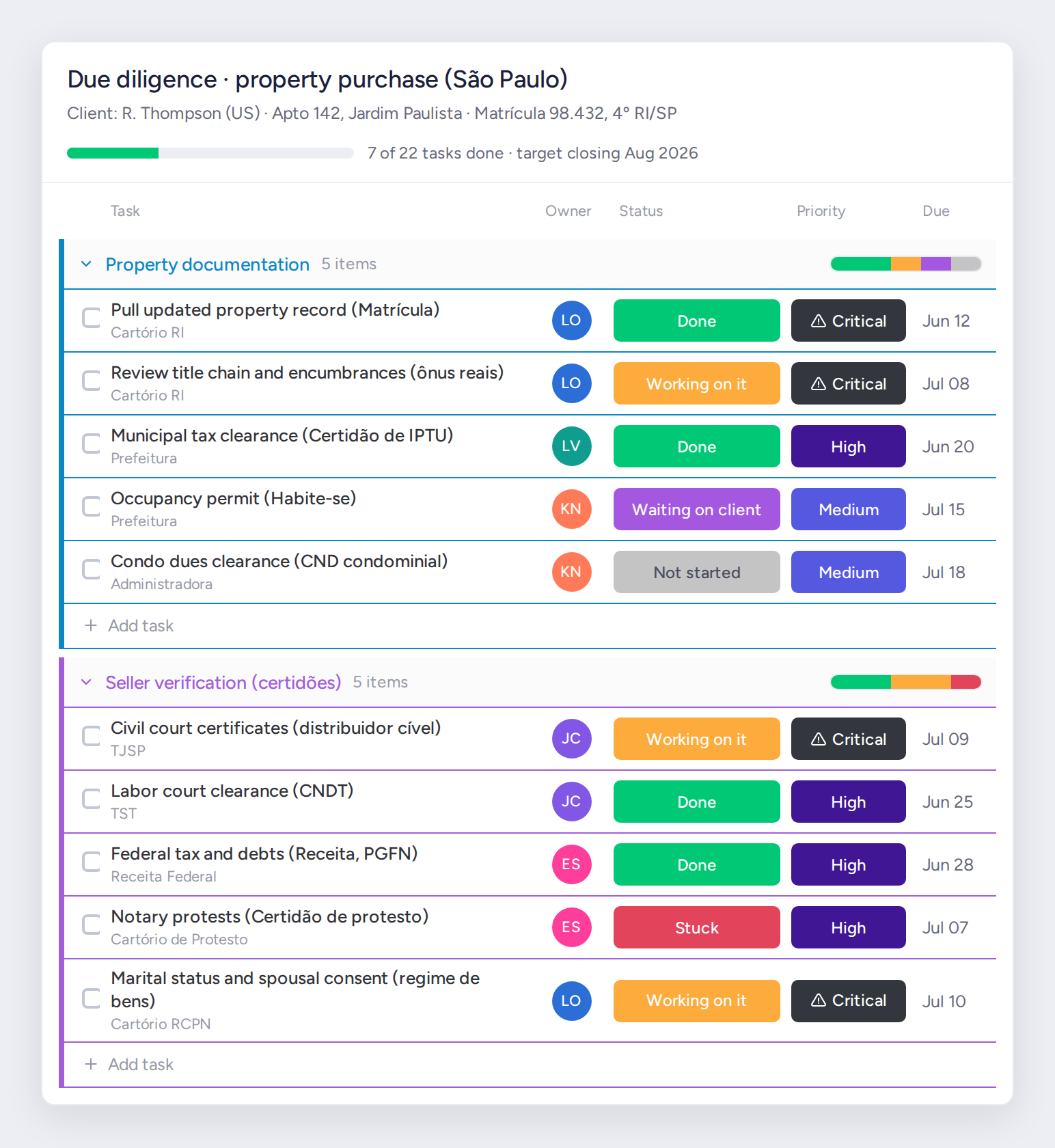
What a lawyer does when you buy property in Brazil — offer to registered title, stage by stage
Before the offer: the seller matters as much as the property
Most foreign buyers assume due diligence is about the property. In Brazil, it is at least as much about the seller. A seller in default with third parties can give rise to claims against the property even after closing — and beyond the obvious checks, transactions collapse over boundaries, probates, divorces, incapacity, multiple sales of the same unit, and sales agreed on paper but never completed with the Escritura and the Registro.
Some findings end a deal on the spot: an unfinished probate, a seller whose debts can reach the property, land that is rural on paper when the listing said urban, a matrícula that does not match what is actually being sold. Finding them before you sign is the whole point of the sequence we run.
And if the property is off-plan (na planta), the diligence targets shift from the finished unit to the developer itself — our off-plan guide covers that variant in depth.
Between signing and closing: where buyers get hurt
The most dangerous stretch of a Brazilian purchase is the gap between the promise to buy and the recorded deed. Brazil has no title insurance and no broadly adopted escrow: if a title fails after closing, nobody refunds you — and sellers will want money before they sign the transfer deed. Walking away from a signed contract is not free either: buyers who discover problems late routinely face losing their deposit, contractual penalties in the range of ten percent, damages, and the realtor’s commission on top.
That is why our sequence front-loads the verification and back-loads the money.
The money: FX, registration, and timing
Oliveira Lawyers never holds client funds. In every closing we run, purchase money moves only through FX banks regulated by the Central Bank of Brazil, under formal partnerships we maintain with the leading currency-exchange banks in the country. Two things decide whether the money side of your purchase goes smoothly: the FX registration made when your funds enter Brazil — your exit ticket when you eventually sell — and the timing of release, so the seller is not paid before the transaction is legally safe to complete. Funds remitted the wrong way end up in what we call money in limbo, stuck between banks and compliance departments while a closing date burns.
Closing at the cartório
Closings happen at registry offices — the cartórios — entities of a mixed public-private nature that record real estate transactions and issue deeds. The cartório requires certificates on both the property and the seller, and it runs its own basic checks; our work is making sure that by the time your closing is scheduled, everything the cartório will ask for already exists, is current, and says what it must say. We review the closing papers ahead of closing day, attend the Escritura on your behalf when you are not in Brazil, and follow the deed through to the Registro de Imóveis. When the deed is recorded, we ship the complete document set — and the keys — to your address.
Every mechanical step of the process is public in our 15-step buying guide. This page is about what it looks like when we run those steps for you.
A glimpse of the work clients rarely expect
The full checklist stays in-house — it took twenty years to build. But here is a glimpse of the work clients rarely expect:
- The transaction explained in your terms — for buyers from the US, UK, Canada and other common-law countries, we translate each Brazilian step into the escrow-and-title vocabulary you already know.
- Your foreign documents, mapped before you start — which documents your side of the transaction needs, and the legalization, apostille, and sworn-translation path for each.
- Clause-by-clause negotiation of the purchase agreement — so you are not signing a contract built to bite you later.
- What is customary versus what is a crime — when someone assures you that declaring a lower price to the registry to cut closing taxes “is how it’s done in Brazil,” we tell you what it actually is: tax fraud, punishable by fines and prison time.
- FX registration, handled in full — the registration made when your money enters Brazil is your exit ticket when you eventually sell; done wrong, it haunts the resale.
- Fund-release timing — we time releases so the seller is not paid before the transaction is legally safe to complete, never prematurely.
- Remittance routing that avoids “money in limbo” — funds stuck between banks and compliance departments routinely wreck closings in transactions that lacked planning.
- Closing papers reviewed before closing day — so nothing on the table surprises you.
- Working relationships with registries across Brazil — long-standing relationships that help resolve registry queries and prevent rejections and re-filings.
Three ways to engage
1. Full support, A to Z
Our main engagement: we run the entire purchase — strategy, seller and property due diligence, contract negotiation, powers of attorney, funds coordination, closing, and registration — under the methodology above, with the tracking board open to you throughout. Most of our clients buy this way; it exists precisely so that a first purchase in a foreign legal system does not have to be an act of faith.
2. Due diligence only
You have a property and a seller; we investigate both and report what we find, deal-killers included, before you commit. If the findings are clean, you can close with confidence — with us or without us.
3. Closing only – for transactions already in motion
Not every purchase that reaches us starts with us. A steady share of our real-estate work is taking over transactions already in progress — sometimes because the buyer’s original counsel stopped answering, sometimes because a lawyer with little experience of foreign buyers ran out of depth, and, every now and then, for more serious reasons. If your purchase is midstream and something feels wrong, the earlier we look, the more options you have. Our closing-only engagement exists precisely for this: experienced eyes on the papers still ahead of you — before you sign and pay.
Two structural protections come with the way we work: Oliveira Lawyers never holds client funds, and in every closing we run, purchase money moves only through FX banks regulated by the Central Bank of Brazil.
A client from the UK came to us after buying rural land to build on. The purchase had closed fast and cheap — and disastrously. The land was still tied up in an unfinished probate. The client had overpaid registry fees by several thousand pounds. The attorney who handled it did not know that a foreign citizen without legal residency in Brazil cannot, as a rule, buy rural property in his own name. And the seller had been paid in full before he could legally sell. By that point, the honest advice was the hard one: litigate to recover as much as possible of what was paid — often the only pathway left in cases like this. Every element of that story is something a properly sequenced purchase is built to prevent: the probate check before the offer, the ownership rules before the property type is chosen, the fees checked against the official cartório tables, the money released only when the law says the sale is safe.
Buying property in Brazil? We can help.
Or write to [email protected]
Who does the work
Real estate transactions at Oliveira Lawyers are personally led by Luciano Oliveira, our managing partner, supported by four team members who each specialize in a part of the real-estate journey — Paulo, Georgia, Livia and Patrick — alongside colleagues who handle investor-visa applications and local procedures in the cities where we keep offices in Brazil: São Paulo, Rio de Janeiro, Brasília and Florianópolis. You will get to know several of them by name; our clients usually do — you can see it in who we are and in what reviewers write.
Why clients trust the structure
Oliveira Lawyers has been doing this since 2004. Today the firm counts 17 team members across offices in Brazil, with more than 400 five-star Google reviews across our offices. We appear on the legal-assistance directories of the US embassy and of Brazilian consulates. The firm holds OAB registrations in Brazil (nacional, São Paulo, Rio de Janeiro and Brasília), and our managing partner is admitted in California, Texas and select US federal courts, alongside memberships in the International Bar Association and the American Bar Association’s International Law Section. Messages are answered by the next business day — often the same day.
“The professionalism really gave me peace of mind during the process of attaining my property.”
— client review, São Paulo office · read our Google reviews
Fees and engagement
Our 40-minute Zoom consultation with Luciano Oliveira is US$125, credited in full toward your services. Fees for purchase representation are quoted for the transaction it is, after a consultation in which you get real advice from the first minute — not a sales call. What we can say is where we sit: our practice runs on the standards you would expect of a US firm or a leading Brazilian firm, and our fee model is designed around protecting the asset rather than billing the clock. After the consultation you receive a scope-and-fees proposal in writing.
Frequently Asked Questions About Buying Real Estate in Brazil with Oliveira Lawyers
1. Why do I need a specialized Brazil real estate lawyer if I already have a realtor?
Realtors find and negotiate properties; they are paid by the seller and their mission is to close the deal. A Brazil real estate lawyer represents you, does deep legal due diligence on the property and sellers, structures the contract for a foreign buyer, coordinates international transfers, and follows through until the title is in your name. In a country with no title insurance and broadly adopted escrow, the lawyer is the one trying to keep you from losing a life‑changing amount of money.
2. What exactly does your “full advisory” property purchase service cover?
In broad strokes, our full advisory for a real estate property acquisition covers the entire life cycle: strategy, initial checks, contract review/negotiation, deep due diligence, guidance on sending earnest money and closing funds, scheduling and supervising the deed, registration of the property in your name, and – when desired – the real estate investment visa process.
We don’t publish a long “menu” of micro‑tasks because we are not selling a commodity; you hire us to own the problem and get you safely from “I like this property” to “I legally own it and can use it for my Brazil plans.”
3. Can you guarantee that I won’t lose money or have problems with my property?
No honest law firm can guarantee that. Brazil has no title insurance or escrow; courts and government offices can be slow; and no one controls every third party involved. What we can do is drastically reduce your risk by investigating the property and sellers, structuring the contract properly, coordinating the money flow, and saying “walk away” when the deal is too dangerous. Our engagement letter also clearly states that we do not guarantee outcomes or specific timelines.
4. How do you actually reduce the risk of buying a bad property?
We run deep due diligence: we check the chain of title, lawsuits, liens, HOA and tax debts, co‑ownership quirks, inheritance or divorce issues, auction history, and more. We also vet the sellers themselves. If we find issues, we explain them in plain English and recommend either protections or walking away. In a system without title insurance, this kind of due diligence is your closest equivalent to “insurance.”
5. Why is buying real estate in Brazil particularly challenging for foreigners?
Because many things work very differently from most buyers’ home countries:
- No title insurance
- No broadly used escrow
- Highly fragmented registry system
- Complex foreign‑buyer requirements (CPF, apostilles, sworn translations, PoA rules)
- Cultural tendency to push short deadlines and “simple” contracts
Our “7 Common Fatal Mistakes” report exists because smart people keep underestimating these differences and paying dearly for it.
6. How is your role different from title insurance or an escrow company?
Brazil doesn’t really have either. We don’t replace an insurer or act as a bank, but we do fill most of the safety gap by:
- Investigating risks that a notary will not block
- Designing the contract to protect a foreign buyer
- Coordinating the release of funds as close as possible to closing
- Refusing fundamentally unsafe properties or sellers
Think of us as your risk‑management hub in a system that otherwise expects you to “take a leap of faith.”
7. At what stage of my property search should I engage your firm?
Ideally before you sign anything or send any money. The best timing is when:
- You’re serious about buying in Brazil; and
- You’re starting to look at properties or have some shortlisted.
We can still help if you come later, but the earlier we join, the more options we have to protect you and to align the purchase with your long‑term plan to be living your dreams in Brazil.
8. Can you help if I already signed a contract or sent money to the seller?
Yes, but our role changes from “preventing” to damage control plus rescue. We’ll review what you signed, map your exposure, and see how much can still be fixed. Sometimes we can renegotiate or restructure the deal; other times, the best move is to minimize losses and not throw good money after bad. The sooner you involve us, the better.
9. Do you also handle the Brazil Real Estate Investment Visa (“Golden Visa”) as part of the purchase?
Yes. For qualifying purchases, we handle the entire real estate investor visa application, from structuring the purchase to meet visa rules to filing the case, answering government questions, and guiding you through Federal Police registration and obtaining your RNM residency card.
That’s how one property can become your gateway to living in Brazil for longer stretches of time.
10. What does a typical client journey with your firm look like from start to finish?
Very roughly:
- Strategy consultation and fit check
- Property selection and initial document checks
- Contract negotiation and initial due diligence (about 10–15 business days)
- Extended due diligence, document legalization, FX setup, and closing prep (around 30–60 days)
- Deed signing (Escritura) and possession
- Registration of the deed in your name (another 30–60 days)
- If applicable, real estate investment visa application and Federal Police registration
Timelines depend heavily on third parties, but this is the general rhythm.
11. Are we likely to be a good fit for each other?
We’re usually a good match if:
- You’re buying with money you cannot afford to casually lose
- You value risk reduction, strategy, and peace of mind over “cheapest possible lawyer”
- You’re open to a structured, step‑by‑step process
If that sounds like you, we’ll probably work well together.
12. What types of clients are not a good fit for your firm?
We’re usually not a good fit if:
- Your main question is “Can you match this cheaper quote?”
- You’re chasing ultra‑cheap auction or “too good to be true” deals
- You want us to “bend” legal or tax rules
- You are not willing to follow a timeline or provide documents on time
- You expect guarantees or want someone else to carry all the risk
We have limited capacity and focus that on clients who understand the stakes and want proper, expert support.
13. Why do you charge a percentage of the property price instead of a flat fee?
Our work scales with the value and complexity of the asset we’re protecting, not with how long each activity takes. A percentage‑based fee:
- Keeps our incentives aligned with protecting a sizable investment
- Reflects that a R$2M–R$4M purchase takes far more coordination than a small matter
- Allows us to include a very broad scope instead of nickel‑and‑diming you for every email
For most clients, the percentage feels like a tiny “insurance‑like” cost against losing a major portion of their net worth.
14. Your fee seems high compared with other providers. Why should I pay it?
Because cheap help in Brazil can be extremely expensive later. Our fee reflects:
- A full‑stack service (real estate + FX + visa + cross‑border issues)
- Deep due diligence that goes beyond what the market does
- Over 200 points of contact we handle so you don’t have to
- The fact that many of our clients come to us after a disaster with another provider
When you compare the fee to the amount you’re investing – and the cost of lawsuits, delays, or visa denial – it usually becomes clear it’s a leveraged decision, not a “cost.”
15. Do you discount or match another professional’s lower fee quote?
No. Asking us to match a cheaper fee is usually a strong signal that we’re not a good fit. Price matching is for commodities, and our work is intentionally not a commodity. We compete on protection, clarity, and outcomes, not on being the cheapest option.
16. If the transaction ends up being simple or some steps are not needed, is your fee reduced?
No. Our percentage‑based fee covers the full suite of professional services from start to finish, whether or not every possible step is required in your specific case. We don’t run a “pay only for the items you used” model; you are paying for us to stand guard over the entire process.
17. What happens to your fee if the first property fails due diligence and I switch to another one?
If the first property doesn’t pass due diligence for legal or risk reasons, your initial retainer can be applied to a replacement property. Our standard agreement covers up to two replacement properties without additional professional fees; only from the third onward would we revisit the fee.
This policy alone has saved clients a lot of frustration when the first choice turned out to be unsafe.
18. Do you work on auction properties, distressed “bargain” deals, or sellers with legal problems?
Generally no. Our agreement explicitly excludes properties:
- Bought at auction
- Involved in serious disputes
- Sold by sellers under criminal investigation for corruption, fraud, or similar
- Priced far below market in ways that usually reflect heavy legal risk
We also don’t work with sellers who insist on misreporting the sale price.
20. How many clients do you work with at once, and what if you’re at capacity?
We intentionally keep our active client list limited so we can give each case the attention it deserves. That means there are times when we are fully booked and will either schedule you for a later slot or politely decline. This is another reason we focus on clients where we can add very high value.
21. Does reading this FAQ, downloading your eBook, or watching your videos make me your client?
No. Our public content is general information, not legal advice for your specific situation. You only become our client when:
- We confirm we can take your case,
- You sign our engagement agreement, and
- We receive the required initial payment.
Until then, you must treat everything as general education information, not as individualized legal guidance.
22. Are you representing only me as buyer, or also the seller / realtor / developer?
We represent you, the buyer. We do not represent the seller, developer, or realtor. Realtors may be in the WhatsApp group and involved in communication, but they are not our client, and we have no duty to protect their interests.
23. Do you provide tax, financial‑planning, or investment‑return advice?
We can explain Brazilian rules that affect your transaction (e.g., some basic tax concepts and visa thresholds), but we do not act as your tax advisor, financial planner, or portfolio manager. Our contract makes clear that we’re not providing tax advice and that you should consult your own tax professionals.
24. Are you licensed to give legal advice outside Brazil?
We do have licenses in the US. This may be helpful for us to explain Brazil real estate transactions in a way that makes sense to you. However, due to our need to reduce liability and make our services available, we specifically provision in our service agreements that we act exclusively as Brazilian attorneys under Brazil jurisdiction in accordance with Brazilian legal ethics. This said, we can coordinate with your home‑country attorney or advisor if needed, but we don’t replace them.
25. Can you promise that my visa will be approved or that my timing will be exactly as estimated?
No. We can design your case to fit the rules, send complete and well‑structured applications, and respond to government questions—but we don’t control consulates, immigration officers, or processing times. Our agreement explicitly states that we do not guarantee outcomes or exact timelines.
Have questions about your specific purchase?
Or write to [email protected]
26. Are you responsible for delays caused by banks, cartórios, registries, or government agencies?
We are responsible for acting diligently and promptly on what is under our control. But we are not responsible for delays caused by third parties like banks, notaries, registries, or government offices. We will push, follow up, and keep you informed – but we cannot force them to move faster than they do.
27. Will you manage the property after the purchase (rentals, bills, condo issues, etc.)?
No. Our role is to help you acquire the property and, if desired, the investment visa. We don’t provide ongoing property management (rent collection, utility payments, tenant issues, etc.). We can introduce you to property managers or concierge services in some cities, but they are separate providers.
28. Do you handle disputes and lawsuits against sellers, developers, or neighbors?
Disputes and litigation are not included in our property‑acquisition advisory. If a dispute arises, we can evaluate whether our litigation team can take the case under a separate engagement, or we can refer you to another local litigator.
29. What is your liability if something goes wrong despite your work?
Our engagement agreement includes a limitation‑of‑liability clause: to the extent permitted by law, our liability is capped at the total amount you paid us under the agreement, except in cases of willful misconduct or gross negligence which are dealt with in accordance with the Brazilian law. We don’t accept open‑ended liability for events we can’t fully control (banks, government, sellers, etc.).
30. Will you give me a detailed checklist of every single micro‑task you perform?
No. Publishing a granular checklist would turn our work into a commodity and invite unhelpful comparisons (“so‑and‑so will do the same list for less”). Instead, we explain the overall steps and outcomes you can expect and then take responsibility for doing what is reasonably necessary to protect you within that scope.
31. How long does the whole process usually take, from choosing a property to deed in my name?
Once you’ve selected a property, initial due diligence and contract preparation usually take 10–15 business days. From contract signing to deed signing and payment, expect roughly 30–60 days, depending on documents, FX, and third parties. After the deed is signed, the registry may take another 30 days to issue the new title in your name.
Investor visa steps come after the title is issued.
32. Can everything be done remotely, or will I need to travel to Brazil?
It’s increasingly possible to do most or all of the process remotely using powers of attorney and tools like e‑Notariado in some states. That said, many clients like to visit at least once to see properties and attend closing. We’ll discuss your options and preferences in the strategy consultation.
33. What documents do I need to get started?
Typically:
- A valid passport
- Basic proof of address and contact details
- Civil status documents (birth certificate if single, marriage certificate if married/divorced)
- For the banking compliance, financial statements and proof of source of funds
Later, these may need apostille and sworn translation for Brazilian use.
34. Can you help me obtain a CPF, sworn translations, and powers of attorney?
Yes. We routinely help clients with:
- Applying for a Brazilian CPF
- Planning the apostille + sworn translation path for vital records
- Structuring a power of attorney that will actually be accepted by Brazilian registries
Our documents and the “7 Mistakes to Avoid” guide explain how underestimating these steps causes many foreigners to miss deadlines and pay penalties.
35. How do you communicate with clients during the transaction?
Most communication happens in a dedicated WhatsApp group that includes you, our team, and, when helpful, your realtor or other local professionals. You can follow everything in real time, ask questions, and see the deal move forward without micromanaging every detail. Email and Zoom calls are also used for more formal discussions.
36. How do you coordinate with my realtor and other local professionals?
We’re used to working alongside realtors, developers, bankers, and notary staff. We coordinate:
- What documents they must provide
- How to adapt their usual process to accommodate foreign‑buyer requirements
- Scheduling of key milestones (earnest money, closing, possession)
Our job is to align everyone around a safe structure so you don’t have to be the project manager.
37. How do you help with sending money to Brazil and timing the release to the seller?
We help you work with Brazilian FX partner banks specialized in real‑estate transactions. Compared to everyday banks, they typically:
- Offer more competitive exchange rates
- Can schedule the day the funds are released to the seller
- Provide proper documentation for Central Bank records and visa compliance
This avoids the classic mistake of sending money straight to the seller’s bank with no control over release timing.
38. Who pays Brazilian taxes, notary fees, registration costs, and other expenses?
In Brazil, it is typically the buyer who pays:
- The real‑estate transfer tax (ITBI)
- Notary and registry fees
- Certain government charges
Total closing costs (excluding our fee) often land around a few percent of the property value. Our role is to guide you on what must be paid, when, and to whom; you are responsible for actually paying those amounts.
Realtor’s fees – on the other hand – are typically paid in full by the seller.
39. What happens on closing day?
On closing day (Escritura):
- The notary prepares the public deed of sale.
- The seller and buyer (or their attorneys/attorneys‑in‑fact) review and sign it.
- The bank releases the funds if that is the agreed schedule.
- You either receive possession (keys) or a contractually agreed move‑out date for the seller.
We review all documents in advance and, when representing you, supervise the signing so you understand what you are accepting.
40. After closing, how do I know the property is really in my name and safe?
After the deed is signed, we file it with the Real Estate Registry Office. Only when the registry issues a new title (matrícula) in your name are you legally recognized as owner. Once that’s done, we forward the new registration to you and explain its contents so you can confidently say “this property is mine.”
41. Apart from risk reduction, what do I actually gain by working with you?
Three big things:
- A much higher chance of ending up financially wealthier instead of stuck in lawsuits or bad deals.
- The ability to show up in your life as the person who genuinely owns a home in Brazil, which is socially and personally interesting.
- A smoother path to spending more time in a place where you can live healthier, more active, more relaxed days.
Plus: time saved, headaches avoided, and a professional team truly on your side.
42. How does your service help me build a wealthier, more attractive, and healthier life in Brazil?
We don’t just tick legal boxes. We help you:
- Choose property types and locations that support appreciation and rental potential (wealthier)
- Secure a base in Brazil you’re proud to invite people to (more attractive)
- Obtain, when desired, residency that lets you actually live the Brazilian lifestyle—fresh food, sun, beaches, outdoor gyms (healthier)
The legal work is the engine behind the life upgrade you’re trying to create.
43. Does working with you improve the financial performance of my investment?
We can’t guarantee returns, but we can:
- Help you avoid properties likely to be legal or financial drains
- Suggest structures and locations that historically attract stronger demand
- Reduce pointless costs (e.g., bad exchange rates, penalties, rushed decisions)
All of this affects how much wealth your Brazilian property ultimately creates rather than destroys.
44. Can you help me decide wherein Brazil to buy?
Yes, at a high level. In a strategy consultation we can discuss:
- Cities and regions that fit your goals (income vs lifestyle)
- Areas friendlier to foreign owners and short‑term rentals
- How each option might affect your visa or long‑term plan
You still make the final choice, but you do it with context, not guesswork.
Ready to buy in Brazil with a team behind you?
Or write to [email protected]
45. Do you provide referrals to trustworthy realtors and other professionals?
Yes. We maintain a network of trusted realtors and other professionals in many Brazilian cities. Realtor referrals are free of charge; we don’t take a commission cut from your transaction. Just tell us your goals and target locations, and we’ll connect you with agents who understand foreign buyers.
46. How do your free resources (eBook, videos, live streams) fit into the service?
They’re your on‑ramp:
- The “7 Mistakes to Avoid” eBook shows you exactly where foreigners go wrong so you don’t repeat their errors.
- Our YouTube videos walk through real‑world cases, scams, and best practices.
- Our live streams on Wednesdays and Sundays let you hear answers to real questions and suggest your own topics.
All of this makes you a more informed, confident client, which makes the paid work more efficient and powerful.
47. What is the first step if I’m considering hiring you?
Book a strategy consultation with one of our Brazil real estate lawyers. In that session we:
- Map your goals and timeline
- Discuss property and visa options
- Discuss risks in any deal you’re already considering
- Decide together whether we’re a good mutual fit
If either side feels it’s not a match, you still leave with a clearer view of your Brazil plan.
48. What if I just want a quick answer by email without paying for a consultation?
You’re welcome to read our articles, download the eBook, and watch our videos for free. But for specific legal answers about your situation, we require a paid consultation. That’s the only way we can responsibly allocate time and accept professional responsibility for our advice.
49. Can I start with a smaller engagement (e.g., contract review) before committing to full advisory?
In some cases, yes – we may offer limited‑scope engagements such as contract review or a targeted risk assessment. However, because of our limited capacity and the complexity of foreign‑buyer transactions, we often recommend the full advisory from the start. We’ll discuss options candidly in the initial consultation.
50. If I’m ready to move forward now, what should I do next?
Simple:
- Contact us with a brief description of your situation (budget, city, timeline, whether you want a visa).
- We’ll reply with next‑step instructions or a link to schedule a strategy consultation.
- If we both agree to work together, you sign the engagement agreement, send the initial payment, and we start mapping your journey to owning a property—and a lifestyle—in Brazil.
51. What is a conveyance attorney in Brazil — and do I need one?
In common-law countries, a conveyance (or closing) attorney runs the legal transfer of ownership. Brazil has no separate conveyancing profession: the work is done by a real estate lawyer, and the closing itself happens at the cartório. Our closing-only engagement is the Brazilian equivalent of white-glove conveyance — purchase and sale agreement, power of attorney, remittance of funds, participation in the Escritura on your behalf, and the recording of the deed at the Registro de Imóveis — with the complete paperwork and the keys shipped to your address at the end.

Related services: due diligence only · buying without traveling · closing funds and FX · selling your Brazilian property · real estate disputes — or start at our real estate practice overview.
Two ways buyers arrive — both welcome
Buyers come to Brazil from two directions, and the practice serves both. Some want the property first — the residency question can wait. Others want residency or citizenship, and the property is how they qualify. Tell us which describes you, even if you are not yet sure, and we plan the path in that order: property-first with the investor-visa option kept open, or visa-first with the purchase planned so it qualifies under the program’s rules from day one — our immigration team and property team are the same firm.
How to choose (and vet) your Brazil real estate lawyer
Choosing the right lawyer matters as much as choosing the right property. Verify OAB registration, confirm they work in your language, and make sure they are independent of the seller and the broker — not the person the other side of your deal recommended. For the full checklist, see our guides on choosing a trustworthy lawyer, the clients good lawyers turn away, and the risks of a cheap or no-upfront lawyer.
Frequently Asked Questions
Do I need a lawyer to buy property in Brazil?
Brazil has no title insurance and no “standard” purchase contract, so nothing backstops a bad title or a one-sided agreement except a lawyer who checks before you sign. We represent the buyer’s side and drive the whole transaction — due diligence, contract, CPF, document legalization, fund-transfer compliance, and registration of the deed. See how to buy in 15 steps or what full-service support covers.
What does a real estate lawyer do that the realtor doesn’t?
A realtor is paid to close the sale; we are your independent protection. We verify the property and the seller, negotiate the contract clause by clause, and handle everything a broker isn’t responsible for. We work alongside good realtors — but we answer only to you.
Can you handle my purchase if I can’t travel to Brazil?
Yes. Most of our foreign-buyer purchases run remotely under a power of attorney; you never need to fly in to buy.
How do I know a Brazil real estate lawyer is trustworthy?
Confirm the lawyer is registered with the OAB (the Brazilian bar), works in your language, and is independent of the seller and the broker. Be wary of anyone who rushes you, requests money before a written engagement, or asks for a personal PIX or WhatsApp transfer.
Do you represent buyers only, or sellers and developers too?
We act for buyers, sellers, and owners; on a purchase, we represent the buyer’s interest exclusively. See real estate sale support.
Additional Content & Resources

This cornerstone page is your overview. From here, you can go as deep as you want.
1. Free eBook – “7 Fatal Mistakes to Avoid When Buying a Property in Brazil”
Before you wire a cent, download our free eBook:
“7 Fatal Mistakes to Avoid When Buying a Property in Brazil”  It It walks you through:
- Why 30‑day closings are dangerous for foreign buyers
- How assumptions about title insurance and escrow can cost you dearly
- The risks of sending money straight to the seller
- FX traps with regular Brazilian banks
- The danger of signing contracts and paying earnest money before proper due diligence
- The hidden time and effort needed for CPF, apostilles, translations, and powers of attorney
This short guide alone can save you from the most common – and expensive – errors.
➡️ [Get the Free eBook Now – 7 Fatal Mistakes to Avoid When Buying Property in Brazil] ⬅️
2. Videos & live streams – learn visually, ask questions live
We publish YouTube videos that break down key parts of buying real estate in Brazil in clear, practical language, including:
1. Buying Property in Brazil: A step-by-step guide (for foreign citizens)
See the real roadmap of a Brazil property deal before you risk your money.
This quick overview walks you through the essentials of purchasing property in Brazil as a foreigner. It covers everything from deciding whether to manage the process yourself or seek professional guidance, to obtaining a CPF tax ID, finding and evaluating a property, and confirming that all the paperwork is in order.
The video encourages watching to the end to understand all the steps and emphasizes the value of careful supervision
2. Brazil Real Estate Investor Visa (RN-36) — Foreign Buyers | Requirements, Costs & Timeline [2026]
Discover how one property purchase can open the door to Brazilian residency.
Interested in Brazil’s investor visa? This video explains how investing R$1 million (or R$700,000 in specific regions) in real estate can qualify you for residency.
It outlines key requirements, such as spending at least 14 days per year in Brazil and ensuring your investment funds come from a verifiable, legal source.
The information provided helps you see if this residency pathway aligns with your plans.
3. Scams in Brazil Real Estate Purchases (explained by a lawyer)
Want to avoid becoming the next “scammed buyer” headline in Brazil?
This cautionary video exposes several common scams in Brazil’s real estate market: sales of properties owned by someone else, fake documents, buyers paying for projects that never get built, and situations where funds disappear.
One example shares a news story in which 300 buyers were tricked in Rio de Janeiro. The overall message is to stay vigilant and thoroughly verify every transaction.
4. Frauds in Brazil Real Estate Transactions (explained by a lawyer)
Learn how to spot hidden fraud in Brazilian property contracts before it’s too late.
Here the video discusses how widespread fraud can be in Brazilian real estate.
It lists different types of fraudulent schemes and underscores the importance of carefully reviewing all documents and property details before proceeding with a purchase.
We also host live streams on Wednesdays and Sundays where we:
- Answer questions from foreign buyers in real time
- Discuss real estate investment strategies, Airbnb rules, and visa options
- Talk about lifestyle, health, and how to build a truly attractive life in Brazil

 Join our live sessions here: Oliveira Lawyers – Live Streams
3. Internal deep‑dive resources – all our real estate pages in one place
From this cornerstone page, you can branch into specialized guides such as:
- How to Buy Real Estate in Brazil as a Foreigner – 15 Steps
- Real Estate Purchase Support & Sale Support in Brazil
- Real Estate Due Diligence, Property Records, and Clearance Certificates
- How to Make an Offer, Downpayment (Sinal), Draft the Purchase & Sale Agreement, and Review the Public Deed
- Document Legalization & Sworn Translation, CPF, and Power of Attorney for Brazil
- Sending Money to Brazil, Closing Costs & Taxes, Attending the Closing & Registering the Deed
- Why & Where to Buy Real Estate in Brazil, including city‑focused pages such as Rio de Janeiro, São Paulo, Florianópolis, and Bahia/Salvador
- Living in Brazil, Brazil Golden Visa (Real Estate Investor Visa), Holding Brazilian Property Through an LLC, and Luxury Real Estate Concierge
Service pages: due diligence · buying without traveling (POA) · closing funds and FX · selling · disputes · investigations.
4. Your next move
If you want to:
- Own a Brazilian property that makes you wealthier through appreciation and rental income,
- Become more interesting by actually having a life in Brazil, not just a fantasy, and
- Live healthier and happier by spending part of your year in a country where good food, sun, and movement are normal…
…then the smartest first step is to get proper legal strategy in place.
👉 Download our free eBook, watch a couple of videos, and then book a consultation so we can map your path from “interested” to “owner.”
Got questions about our services? See here the most common questions and their answers.