

Brazil Marriage Residency Specialists: Legal Support for Your Life Together

Build your life together in Brazil with a law firm to support your whole journey. Oliveira Lawyers handles residence applications based on marriage or a stable union with a Brazilian citizen, for couples abroad and already in Brazil. Our bilingual full-service firm is led by Luciano Oliveira, an attorney licensed in Brazil, Texas, and California.
Our selective approach. We focus on full representation for clients who value their time, want candid advice, and prefer an established international law firm to manage the legal work. Oliveira Lawyers was built from the ground up to help foreign citizens like you succeed in Brazil. Learn more about our firm and approach.
Why Foreign Citizens Trust Oliveira Lawyers
- Judgment and experience that matter. We review your marriage or stable-union evidence and plans to live together in Brazil. Foreign marriage records, prior divorces, and differences between identity documents receive individual attention.
- An attorney responsible for your case, with progress you can follow. Our attorneys and team coordinate preparation, submission, and responses to immigration authorities. Your online board shows documents and the next steps.
- Staffed offices in Brazil, with support abroad. Our Brazilian offices provide local support, while our U.S. offices coordinate documents such as background checks, birth certificates, and apostilles, reducing the work you have to coordinate across countries.
- Support at your Federal Police appointment. We schedule the appointment, organize your relationship documents, and prepare you for questions about your life together. Professional accompaniment is available in all major Brazilian cities.
- A relationship that makes the next step easier. Your plans as a couple may involve registering a foreign marriage or recognizing a prior divorce. Turn to a firm familiar with you for family, property, tax, and estate matters.
Experience you can verify when hiring us. Oliveira Lawyers has hundreds of Google reviews. Couples describe clear explanations, careful preparation, and responsive support. Read selected marriage and stable-union client reviews below, and watch our video on marriage residency mistakes.
Start with an online consultation to discuss your relationship documents, plans as a couple, and what representation would involve.
Understanding Residency in Brazil Through Marriage or a Stable Union
Reviewed by Luciano Oliveira — Brazil–US attorney, LL.M., licensed in Brazil, Texas, and California · Last reviewed: July 2026.
Before we dive in: what follows is general information about Brazilian immigration law — it isn’t legal advice, and no page can tell you whether your own case qualifies. That takes a consultation with a licensed attorney who has seen your documents.
This guide explains residence applications based on marriage or a registered stable union, the documents involved, and the distinction between residency and a later citizenship application.
For many couples, returning to Brazil or moving here can raise questions about how to obtain permanent residency for a Brazilian citizen’s spouse or partner. This type of immigration regularization is referred to by various names, such as a marriage visa, residence authorization for a foreigner married to a Brazilian, immigration by marriage, family regrouping, partner visa, or even a family visa. Regardless of what it is called, the objective is the same: to enable a foreigner to live in Brazil alongside their Brazilian partner, with all the rights and obligations of a legal resident. If you are not married but live in a committed relationship, the same door may open through a stable union in Brazil (união estável), including for same-sex couples.
Portuguese (BR) version available — share it with your Brazilian family.
Before you apply: Brazil generally needs your marriage on its own records first — see how to have your foreign marriage recognized in Brazil. And if either spouse was divorced abroad, you usually must homologate that prior foreign divorce before it counts here.
How can we help with your marriage or stable-union residency plans?
Have legal questions?
Discuss your marriage or stable union, residency options, and possible next steps in a consultation with an immigration attorney.
Consultation fee credited in full toward our professional fees when you hire us.
A professional-fee estimate?
Tell us briefly about your plans as a couple and the assistance you need. We’ll review your inquiry to prepare an estimate of our professional fees.
For substantive legal questions, please choose a consultation.
How Oliveira Lawyers assists spouses and partners
Our immigration team assists foreign spouses and partners of Brazilian citizens with preparing a residence application based on marriage or a registered stable union.
- Relationship and personal documents: we review the records needed to support the application and identify missing or inconsistent documentation.
- Application planning: we discuss the route and next steps in light of where you live, your travel plans, and your existing immigration status.
- Related document work: where a foreign marriage or prior foreign divorce affects the application, we identify the related recognition or registration work to discuss before filing.
Couples can begin with an online consultation from Brazil or abroad. We assist with immigration matters across Brazil. Any related document work is discussed as part of the engagement scope, and remote support does not replace appointments the authorities require you to attend personally.
The legal reviewer of this guide is Luciano Oliveira. If your family relationship involves a relative other than a Brazilian spouse or partner, see our family reunion service.
1. Why the Confusion Over Different Names
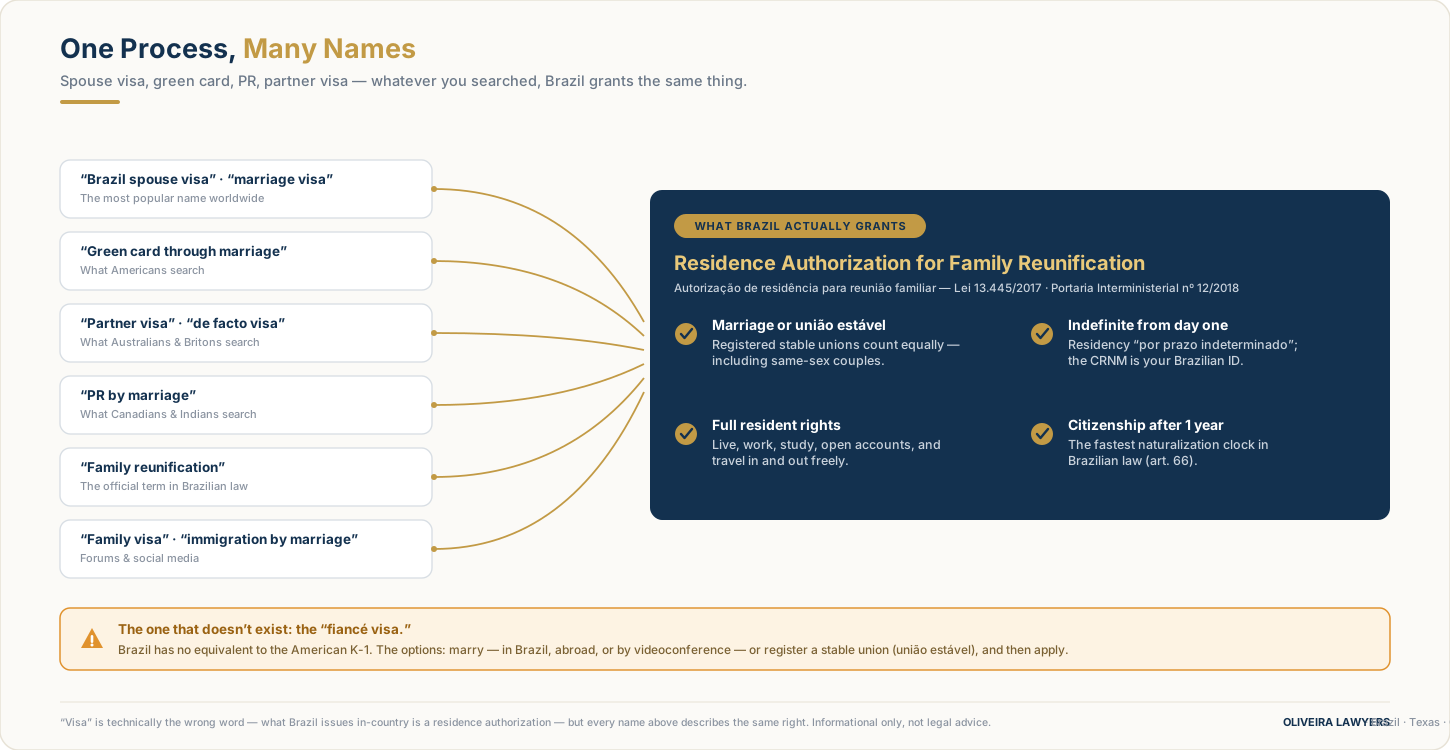
It is common to find various names for the process of obtaining a residence permit for a foreign spouse, as each situation involves specific legal scenarios and approaches. Below are a few reasons why different terms end up being used.
1. Residence Authorization for Family Reunification. This is the official title of the procedure. It makes a lot of sense when the foreigner enters Brazil to reunite with a Brazilian partner who is already established in the country. The focus is on the “reunification” of a family that is temporarily separated. It is a technical term used in official documents and in Brazilian Migration Law, including Lei 13.445/2017 and Portaria Interministerial nº 12/2018.
2. Permanent Residency for a Foreigner Through Marriage. If both spouses are living abroad and decide to move to Brazil together, the term “family reunification” loses part of its meaning because the couple is already together in another country. In this case, phrases such as “permanent residency” or “residence authorization by marriage” are preferred. This is our firm’s preferred term because it highlights the pursuit of a long-term or definitive solution for the foreigner.
3. “Brazilian Spouse Visa” or “Marriage Visa.” In many countries, any entry permit is referred to as a “visa,” whether it is temporary or permanent. Thus, many people use terms such as spouse visa or marriage visa to describe the entire procedure. Although it is a popular and technically imprecise expression when referring to permanent residence by marriage, it shows that the legal basis for the application is the marriage or family bond.
4. “Immigration Process by Marriage.” Some people prefer a broader term that does not focus strictly on a visa or residence authorization. In this context, it covers the entire migration procedure that allows the foreign spouse to reside in Brazil, from legalizing the marriage abroad to obtaining Brazilian documentation. This term often appears in forums, social media groups, and Q&A websites.
5. Imported vocabulary: “partner visa,” “green card,” and “PR.” Searchers bring their home country’s system with them. Australians and Britons ask about a Brazil partner visa or de facto visa; Americans ask for the Brazilian green card through marriage; Indians and Canadians ask about PR. None of these exist under those exact names in Brazil. What exists is the residence authorization this page describes, which functions like all of them: live, work, study, come and go freely, and naturalize. There is also no Brazilian fiancé visa equivalent to the American K-1.
If you plan to live in the US instead, the route is the K-1 fiancé visa for your Brazilian partner.
All these names describe the same right that the foreign national has to live legally in Brazil through marriage or stable union with a Brazilian. Each expression highlights a different nuance of the process, but the legal route is the same.
Selected five-star client reviews
Marriage and stable-union residency · Excerpts from public Google reviews.
Mike Hays
Apr 14, 2025 · Google
★★★★★
Residence through marriage
“A special thanks to Patrick Moreth who did an incredible job in preparing and prepping and making the Obtaining of my marriage based permanent residency in Brazil a success. The professionalism and followup was wonderful and i highly recommend to anyone needing his assistance in the visa processes”
Revan 7474
Sep 24, 2025 · Google
★★★★★
Residence through marriage
“He immediately had a video consultation with my wife and I, in which he started explaining the process of permanent residency in Brazil by marriage.”
Michael E Lind
18 weeks ago (recorded October 1, 2026) · Google
★★★★★
Stable union and family-based residence
“… combined extraordinary expertise and experience with strategic insight and sympathetic support in guiding me as a U.S. citizen in Brazil successfully through the complex processes involved in obtaining a CPF, stable union status and a family-based residency visa.”
Jacob Nunes
36 weeks ago (recorded October 1, 2026) · Google
★★★★★
Marriage visa
“They helped me with my marriage visa and everything was stress free and they always responded to my communications. I would recommend and definitely I will use them in the future.”
Read 1 more client review
Kevin Anthony Prall
37 weeks ago (recorded October 1, 2026) · Google
★★★★★
Retirement and marriage visas
“Sara and the team have been very attentive and professional in handling our retirement and marriage visa processes.”
Selected reviews describe individual experiences, not guaranteed outcomes. Review wording is preserved in these excerpts; use the source links to read each full review.
2. The Honest Timeline: Indefinite From Day One — But Conditional
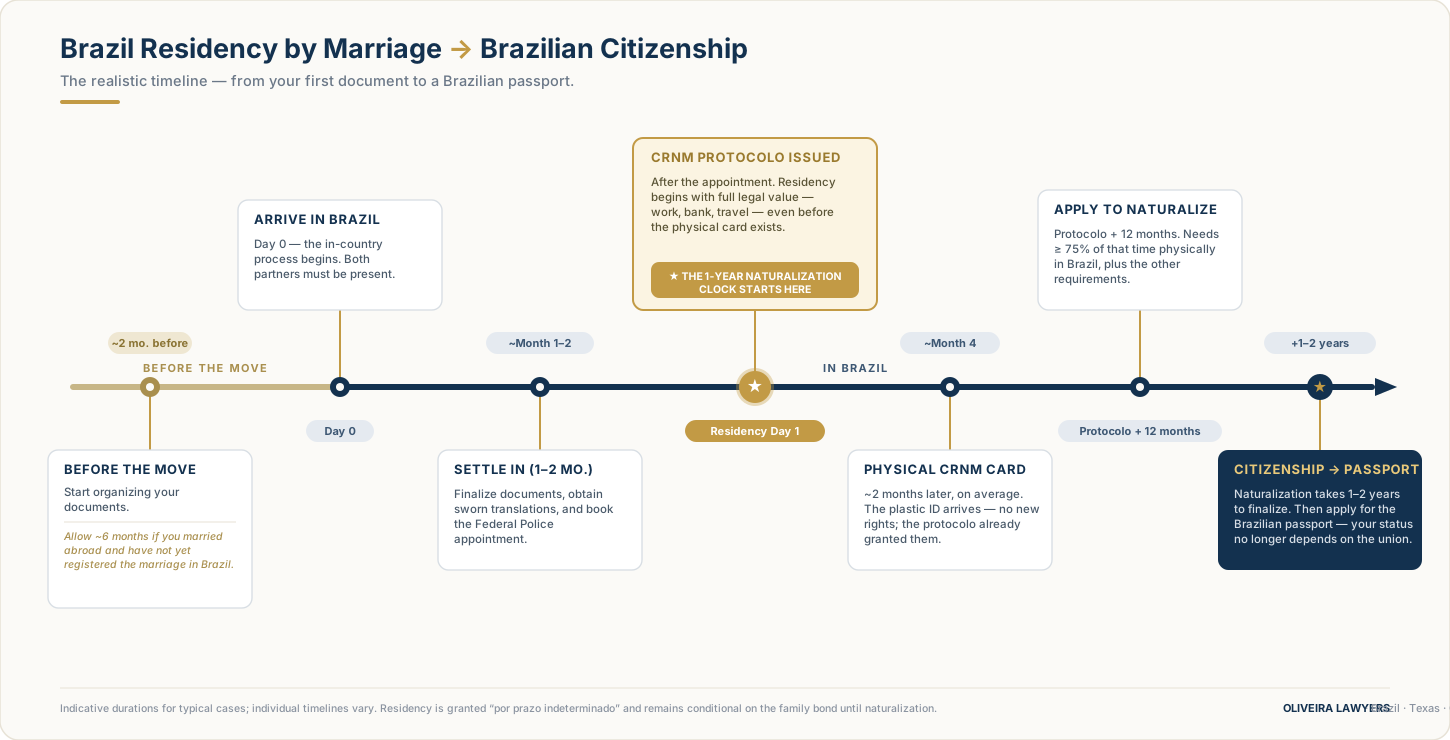
Here is what most websites get wrong in both directions. Brazil permanent residency by marriage, the spouse visa as most clients call it, works like this: when the person calling you to Brazil, the chamante, is your Brazilian spouse, stable-union partner, child, or parent, the residence authorization is typically granted por prazo indeterminado — for an indefinite period — from day one. There is no mandatory two-year probation built into the marriage route, unlike what many blogs and some older content suggest.
Temporary two-year grants do happen in specific profiles, for example a very recently registered stable union with thin supporting evidence, but they are the exception, not the rule.
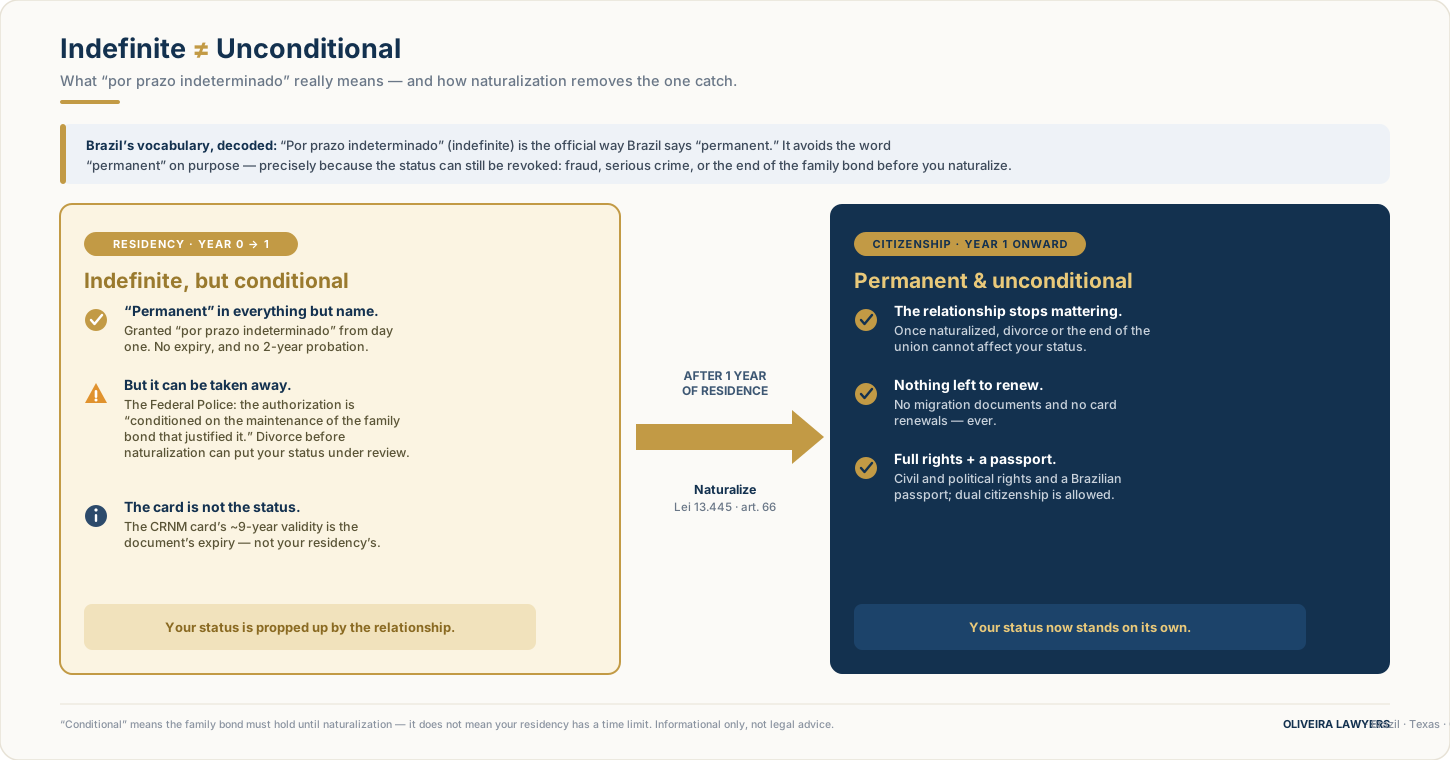
Now the other direction: “indefinite” does not mean unconditional. The residence authorization for family reunification is conditioned on the maintenance of the family bond that justified it. Divorce or the end of the union before naturalization can put your status under review. That is why we tell clients the honest sequence is: Year 0 — residency por prazo indeterminado, conditional on the relationship. Year 1 — eligibility for Brazilian citizenship by marriage through naturalization under Lei 13.445/2017, art. 66, after which no marriage-based condition can touch your status.
One more trap: the CRNM card often shows a validity date. That is the document’s expiration, like a passport needing renewal, not the residency’s expiration. Renewing the card is bureaucracy; the residency itself remains indefinite as long as the family bond stands. Compare this with our Brazil Golden Visa guide, where residency starts with a four-year authorization and citizenship takes four years of residence. Marriage is, by far, Brazil’s fastest lane.
3. Can I Get Brazilian Citizenship by Marriage Without Living in Brazil?

In one word: no. This is the most-searched misconception in this entire subject, so let us be precise. Marrying a Brazilian, by itself, gives you no automatic citizenship and no automatic residency. Brazil citizenship by marriage, in the literal passport-from-the-wedding sense, does not exist. Citizenship through marriage is earned in Brazil, not at the altar.
What marriage or a registered stable union gives you is the right to claim residency. Naturalization under art. 65 of the Migration Law requires effective residence in Brazil. Living abroad with your Brazilian spouse, you can prepare: register the marriage in Brazil, gather apostilled documents, and even obtain a consular family reunification visa, usually valid for 12 months, to organize the move. But the citizenship clock only starts once you actually reside in Brazil with residency granted.
If your plan is citizenship without relocating, this route is not your answer. If your plan is to move to Brazil, Brazil residency by marriage is the fastest route that exists: one year of residence as the spouse or partner of a Brazilian, Portuguese proficiency, a clean record, and the marriage intact at the time the naturalization is decided.
4. Basic Concepts and Who Is Eligible — the Four Tests

Brazilian immigration law provides that foreigners married to Brazilians, or in a formally recognized stable union, may apply for residence authorization through marriage. Proof of this relationship can be provided by a marriage certificate or by a stable union deed duly registered at a notary’s office.
Test 1 — The relationship
- Partners of Brazilians who hold a valid marriage certificate, whether celebrated in Brazil or abroad, provided the foreign marriage is later registered in Brazil.
- Couples in a legally recognized stable union in Brazil or with an equivalent foreign document that has been legalized or apostilled.
Test 2 — The presence
Both partners must be physically present in Brazil for the Federal Police application. Couples abroad should review the consular route and the citizenship-without-living-in-Brazil section above.
Test 3 — The proof
The relationship must be documentable and genuine. This may include joint accounts, shared residence, shared expenses, witness declarations, and Federal Police review.
Test 4 — The applicant
The applicant must have a clean criminal record, certificates from every country of residence in the last five years where required, apostilled or legalized documents, a valid travel document, and truthful declarations. False statements can create criminal exposure under art. 299 of the Brazilian Penal Code.
Who Does Not Qualify
- Fiancés without a formal marriage or stable union.
- Couples who cannot prove the relationship through legally recognized documentation.
- Those who are still abroad and have not entered the proper consular or in-country route.
- Those with no intention to remain in national territory.
Remember that through consulates or embassies abroad, one can typically only apply for the Family Reunification Visa, which is usually limited to 12 months.
5. The Stable Union Route in Brazil (União Estável) — Including Same-Sex Couples

Brazil treats a registered stable union, união estável, as a residency-granting family bond on equal footing with marriage. The legal basis includes Civil Code art. 1.723 and the family-reunification rules in Portaria Interministerial nº 12/2018. For many clients this is the faster, simpler door: no wedding formalities, no publication of banns, and no foreign marriage to transcribe.
The couple declares the union at a notary office (cartório), typically with witnesses, and the registered deed (escritura de união estável) becomes the document that anchors the residency and, one year of residence later, the naturalization application.
Same-sex couples are fully covered. Since the Supreme Federal Court’s 2011 decision in ADPF 132 and ADI 4277 and CNJ Resolution 175/2013, same-sex stable unions and marriages are recognized throughout Brazil, and the immigration rules apply without discrimination. Our team has taken same-sex couples from cartório registration to residency por prazo indeterminado. The process is identical.
Although in theory it is possible to request residence authorization based on an unregistered stable union, our firm does not assist with this type of application due to the difficulties in obtaining supporting documentation and the high likelihood of refusal by Brazilian immigration authorities. Register first, then apply: a few hundred reais at the cartório can buy you a clean, defensible application.
One honest caution before you register a union for immigration purposes. A união estável is not an immigration form — it is a family-law status with real consequences: depending on the property regime, assets acquired during the union are shared, and support obligations can follow if it ends. Entering one hastily to unlock a residency is how people win the immigration case and lose something bigger later. Register it because the relationship is real; the residency then follows honestly.
Brazilian spouse visa?
We can help.
[email protected]
(214) 432-8100
+55-21-2018-1225
#1 Contact us for a confidential scoping review, or
#2 Schedule a consultation now.
6. Main Requirements and Necessary Documentation

To obtain permanent residency in Brazil through marriage or stable union, the correct documentation must be gathered. Requirements can vary depending on the state, the Federal Police station, and the foreigner’s circumstances.
A note from practice: individual officers have real discretion here — one may accept a document that another questions, and requests for additional evidence are routine. Bring more than the minimum, with dates as fresh as possible.
1. Documents of the Brazilian Citizen
- RG issued within the last 10 years or a valid Brazilian driver’s license.
- Some Federal Police stations will not accept only a Brazilian passport. Their reasoning is that it makes no sense for a Brazilian supposedly residing in Brazil not to have a valid ID such as RG or driver’s license. They may assume the person actually resides abroad and is only applying for their spouse’s permanent residency as a convenience.
- Proof of residence in Brazil, such as electricity, water, telephone, or similar bills.
- Statement of address and contact information, including phone number and email.
- Declaration of residence in Brazil with criminal liability for false information.
2. Documents of the Foreigner
- Valid passport, including identification pages and Brazilian entry visa if applicable.
- Birth certificate with apostille when required by the immigration authority.
- Criminal record certificate with apostille from the country of origin and any country where the foreigner has lived in recent years, depending on the Federal Police station. In the United States, this usually means an FBI fingerprint-based criminal record report apostilled in Washington, DC.
For US citizens who are already in Brazil, this FBI report is typically the hardest document in the whole file — the fingerprints have to be taken on the official FBI card, and most people assume that means flying home. It doesn’t have to: we keep official FBI fingerprint cards in stock at our offices, one of the few firms in Brazil that does, so the fingerprint step can be completed here.
3. Couple’s Document
- Marriage certificate or stable union document issued by a Brazilian notary’s office. If the marriage took place abroad, it must first be registered in Brazil. Don’t underestimate this step: an unregistered foreign marriage is one of the most common bars we see in practice — the residency application simply cannot stand on a marriage Brazil doesn’t yet recognize. Register the marriage first; then build the residency case on top of it. This may involve consular registration, apostilles, sworn translations, and Brazilian notary registration. See our page on how to register a marriage in Brazil.
- For the stable union route, the equivalent document is the registered escritura de união estável.
Foreign public documents may require apostille under the Hague Apostille Convention as promulgated in Brazil by Decreto 8.660/2016, plus sworn translation in Brazil when required.
Download our latest checklist to receive guidance and ensure your eligibility:
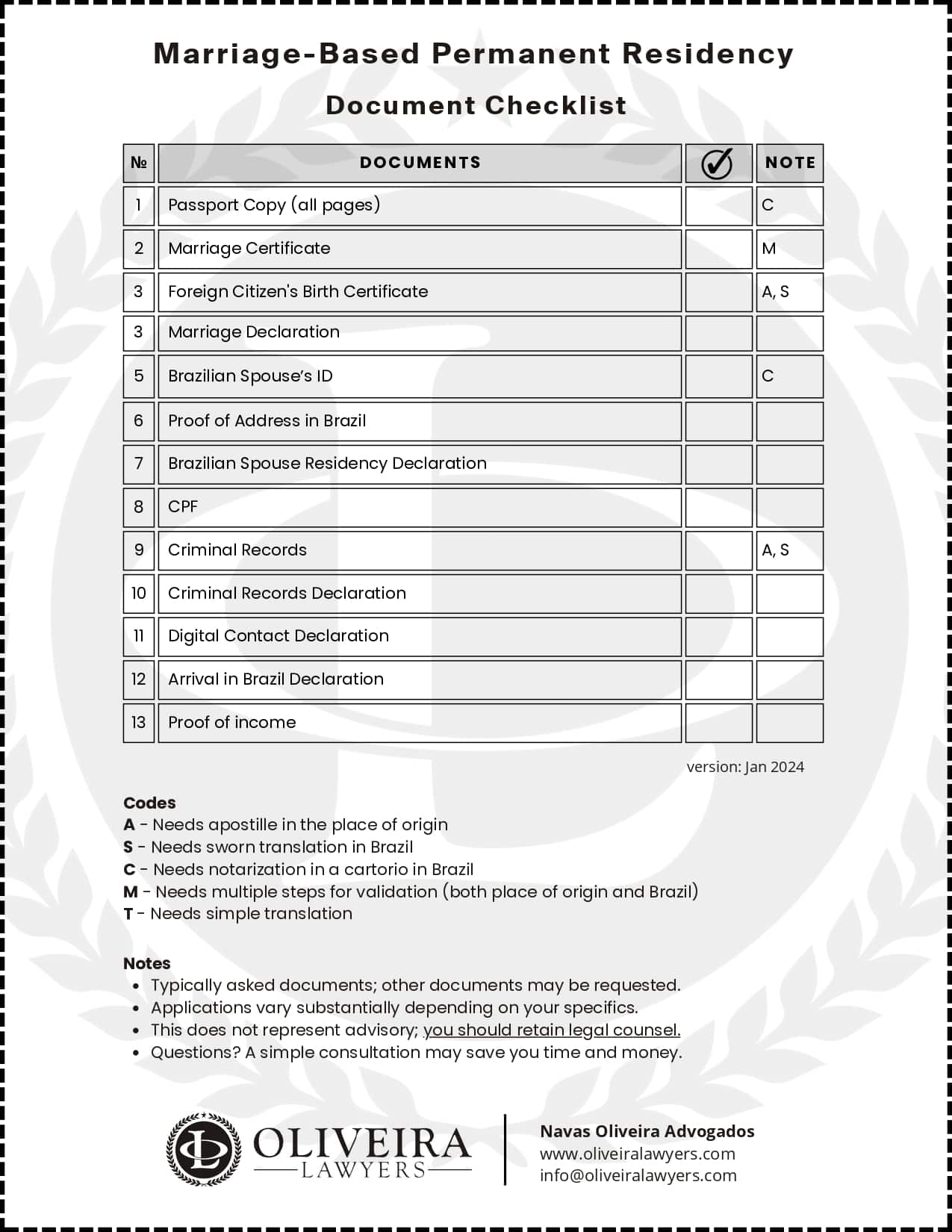
Download a PDF/image version of our checklist.
7. Step-by-Step Guide to the Process

1. Preparation and Gathering Documents
- This is a fundamental step to avoid delays. Check if all documents required by Brazilian law are up to date.
- One of the most time-consuming documents to obtain will be a marriage certificate issued by a notary’s office in Brazil if your marriage was held abroad. Allocate several months to register your marriage in Brazil if you have not already done so.
- Another step to take before moving to Brazil is obtaining your criminal background check. This document must be apostilled in the country of origin. For couples who cannot travel at all, ask us about the consular family reunification visa.
2. Submitting the Application
- In most Brazilian states, our office can submit the documentation for preliminary inspection by the Federal Police and schedule an interview date. The process always begins with the Federal Police in Brazil for residence authorization. Consulates abroad generally issue only the 12-month family reunification visa, not the final in-country residence authorization.
3. Federal Police Review
- On the scheduled day, you must appear at the Federal Police office, where documents are reviewed. Your attorney files the application beforehand through MigranteWeb, the system developed by the Brazilian authorities. A protocol number is generated, allowing the foreign spouse to remain in the country while awaiting the result.
- The protocol is more powerful than it looks: with it, you can often work legally and open the path to services while the card is produced. However, it is not uncommon for the RNM to be canceled later if the Federal Police discover irregularity, such as the spouses not actually living in Brazil.
4. Issuance of the CRNM (National Migration Registration Card)
- Formerly known as the RNE, the CRNM is the foreigner’s ID in Brazil.
- For spouses and stable-union partners of Brazilians, the residence authorization is typically granted por prazo indeterminado from day one. Temporary two-year grants occur only in specific profiles, such as very recent unions with thin evidence.
- The card itself is commonly issued with a validity date. Remember: that is the document’s expiration, not the residency’s. You will know that your residency is considered indefinite if it states por prazo indeterminado.
- Brazilian authorities avoid the practical word “permanent” because residency can still be revoked in cases of fraud, criminal activity, abandonment, or if the family bond that justified it ends before naturalization.
8. Differences Between Temporary Residency and Permanent Residency
Family Reunification Visa
- Issued only by Brazilian consulates and consular sections of some Brazilian embassies, this visa typically allows the foreigner to stay in Brazil for up to 12 months.
- By starting with this visa, the immigrant can then apply for the Residence Authorization for Family Reunification in Brazil during the 12-month period.
Digital Nomad Residence
- This can be obtained directly in Brazil by immigrants who meet the digital nomad criteria.
- This residence is usually valid for up to 12 months and can be renewed one or more times.
- It can serve as a bridge if the foreigner cannot obtain permanent residency due to a documentation issue that cannot be resolved in a few months, such as a Brazilian spouse who divorced abroad but never recognized the divorce in Brazil.
Permanent Residency
- In the standard case where the chamante is your Brazilian spouse, partner, child, or parent, residence can be granted directly por prazo indeterminado.
- It grants the right to stay in Brazil indefinitely, provided that no factors leading to loss of the right occur, such as serious crimes, long abandonment of Brazilian territory, fraud, or the end of the family bond before naturalization.
9. The Rights You Gain — Including Two Almost Nobody Mentions

- Work from the protocol. Under the family-reunification rules, someone married to a Brazilian or in a registered stable union may exercise activities, including paid work, on equal terms with Brazilians. In practice, the Polícia Federal protocol already documents your status while the CRNM card is produced.
- Full resident rights. The CRNM serves as your Brazilian ID for bank accounts, driver’s license, SUS healthcare, education, and entering and leaving Brazil freely.
- The expulsion shield. Art. 55 of the Migration Law bars the expulsion of a foreigner who has a Brazilian spouse or partner residing in Brazil, or a Brazilian child under their care or dependency, without discrimination.
- The one-year citizenship clock. This is the shortest naturalization runway in Brazilian law, detailed below.
There is also a consequence to gaining these rights that almost nobody mentions: residency generally makes you a Brazilian tax resident, taxable on worldwide income (the same happens after 183 days of presence in a 12-month window). For some couples that changes nothing; for others it reshapes the financial plan — and it deserves a look before you file, not after. → Residency and tax residency
10. Federal Police Scrutiny: How They Verify — and When They Revoke
This residency assumes that the couple truly lives in the country, not just on vacation or passing through. It is important not to attempt to “fool” immigration, as that can lead to issues with the Federal Police.
In some cases, the Federal Police conduct unannounced visits to confirm that the couple actually lives at the address provided. If the address is intentionally incorrect or false, the application may be denied — and it doesn’t end there. Even after a residency is granted, a later visit showing you do not actually live there can lead to cancellation of the residency and a formal investigation. Faking a presence in Brazil is the single most damaging mistake in these cases. The Federal Police may also summon the couple for separate interviews and request additional evidence of a genuine relationship. If they conclude it is a marriage of convenience, the application can be denied and the foreign national may be deported, with possible criminal charges for misrepresentation.
Family changes can also matter. Divorce, death of a spouse, or other changes may affect residency. Until naturalization, the relationship is the foundation of your status, which is exactly why the one-year citizenship window matters so much.
What the appointment at the Federal Police is actually like
Clients often expect an interrogation. The reality is usually more mundane — and more bureaucratic. Most of the appointment is document review: the officer goes through your file piece by piece, checks validity dates, apostilles and translations, and confirms you have an established physical address. Expect a few questions about the relationship — how you met, how you live — but the paperwork is the star of the show. Two practical points people miss. First, apply at the Federal Police station that covers where you actually live: applicants who show up from another state, or even a distant city in the same state, are routinely turned away. Second, appointments vary — some are brief, some take much longer, and more than one visit is common — so build slack into your plans rather than betting on a single morning.
11. Tips to Avoid Problems in the Residency Process

1. Start the Process Preferably While Still Abroad
When obtaining documents such as apostilled certificates and criminal background checks in the country of origin, it is much simpler and faster to do so before traveling. For couples who cannot travel at all, ask us about the consular family reunification visa.
2. Both Spouses Must Reside Permanently in Brazil
Residence authorization assumes that the couple truly lives in the country, not just on vacation or passing through. Do not attempt to fool immigration.
3. Be Prepared for Possible Federal Police Visits
In some cases, the Federal Police conduct unannounced visits to confirm that the couple actually lives at the declared address.
4. Do Not Expect the Federal Police to Act as a Consultancy Service
The Federal Police analyzes applications. It does not teach applicants how to register a foreign marriage, apostille documents, or build the case.
5. Consider Hiring Specialized Legal Services
This procedure involves documents, deadlines, translations, apostilles, and local Federal Police practice. Experienced counsel can reduce delay and risk.
6. Finalize Any Divorces from Abroad Before Starting
If the Brazilian spouse was previously married abroad but did not recognize that divorce in Brazil, this can become a major obstacle.
7. Be Aware of Differences in Procedures Between Federal Police Stations
Each Federal Police unit may have its own practical requirements and scheduling procedures. Do not assume another person’s case will work the same way.
8. Obtain Specialized Legal Advice
Oliveira Lawyers provides support for marriage visa, Brazilian spouse visa, family regrouping, stable union, and other migration processes.
9. Legal Services Have a Minimum Fee Set by the OAB
The Brazilian Bar Association sets minimum fee references for legal consultation and advisory services, and fees vary by scope and jurisdiction.
10. The OAB Prohibits Completely Free Legal Consultations
Brazilian bar rules generally prohibit attorneys from offering legal consultations entirely free of charge.
11. Stay Up to Date with Legal Changes
Brazilian immigration laws and Federal Police practices undergo periodic updates. Always confirm the current rules before filing.
12. Brazilian Citizenship by Marriage: Naturalization After One Year

For the foreigner who obtains residency based on marriage or stable union with a Brazilian, there is an accelerated path to acquiring Brazilian citizenship. After one year of residency, while maintaining a valid and uninterrupted marriage or stable union, you may apply for naturalization. This is what people mean when they search for “Brazil citizenship in 1 year,” and it is what the Brazil citizenship by marriage requirements actually amount to.
The legal basis is art. 66 of the Migration Law, which reduces the ordinary four-year residence requirement of art. 65 to one year for the spouse or companion of a Brazilian. You must not be legally or factually separated at the time naturalization is decided. The marriage must hold through approval, not merely through filing.
Basic Requirements:
- Residency por prazo indeterminado granted and registered with the Federal Police.
- Valid marriage or stable union with a Brazilian citizen, duly documented and uninterrupted.
- One year of effective residence in Brazil after obtaining the residency.
- Good conduct and absence of serious criminal records.
- Sufficient command of Portuguese to demonstrate social integration.
Advantages of Brazilian Nationality: full civil and political rights; Brazilian passport; diplomatic protection abroad; no need to renew migration documents. Brazil allows dual citizenship, although you should check your home country’s rules. Once naturalized, your status no longer depends on the marriage.
No Brazilian partner? The investment route gets you to the same passport on a four-year clock. See our Brazil Golden Visa guide.
13. Looking for Something Slightly Different?
- Bringing your Brazilian spouse to the United States? That is the reverse direction — CR-1/IR-1 and K-1 fiancé visas. See our US immigration practice.
- Family reunification for parents, children, or siblings of Brazilians? Same legal family, different page. See our Brazil family reunion visa guide when available.
- Need to register a foreign marriage or recognize a foreign divorce first? Those are gateway steps. See our foreign marriage recognition guide.
- Português? Use the Portuguese version of this page if you need to share the information with your Brazilian family.
Children and dependent parents can follow you through the Brazil family reunion visa.
14. Frequently Asked Questions about Permanent Residency by Marriage

1. Can I become a Brazilian citizen by marriage?
Yes, in two steps, not one. Marriage or a registered stable union with a Brazilian gives you the right to apply for residency by marriage. After one year of effective residence in Brazil with the relationship intact, plus Portuguese ability and a clean record, you may apply for naturalization. There is no automatic citizenship from the wedding itself and no path that works entirely from abroad.
2. Can I move to Brazil if I marry a Brazilian?
Yes. If you are married to a Brazilian or in a registered união estável, you may qualify for residency by marriage, typically granted for an indefinite period from day one when you apply together at the Federal Police in Brazil.
3. What are the different names people use for this process?
People search for marriage visa, Brazilian spouse visa, partner visa, de facto visa, green card through marriage, PR by marriage, family reunification, and permanent residency by marriage. These labels point to the same Brazilian legal route: residence authorization for family reunification based on marriage or stable union with a Brazilian.
4. Is it mandatory to return to my country of origin to apply?
No. If the foreign national is already in Brazil in valid legal status, they can apply directly at the Federal Police. If the foreign national is abroad or in irregular status, the consular family reunification visa may be relevant and should be reviewed case by case.
5. Can I work in Brazil while waiting for my residence document?
Generally, after filing the residence authorization application, the Federal Police issues a protocol that documents the pending process and, in many cases, already allows the foreign national to work legally in Brazil while the CRNM card is produced.
6. How long does the residence authorization take?
The preparation of documents usually takes longer than the processing itself. Some Federal Police stations grant the authorization on the day of the appointment, while the CRNM card often becomes available one to three months after the protocol.
7. Do I need to speak Portuguese?
Portuguese is not required for the residency application itself. Portuguese ability becomes important for naturalization, where the applicant must demonstrate sufficient communication ability and social integration.
8. How long is the CRNM valid?
For spouses and stable-union partners of Brazilians, the residency is typically granted por prazo indeterminado from day one, while the CRNM card itself may show a document validity period, often nine years. The card expiration is not the same as the residency duration.
9. Can I get Brazilian citizenship by marriage without living in Brazil?
No. Brazilian citizenship by marriage requires effective residence in Brazil. A consular family reunification visa can help organize the move, but the citizenship clock starts after residency is granted and the person actually lives in Brazil.
10. Could I face problems if I stay outside Brazil for a long period?
Yes. To maintain residence status, the foreign national should actually reside in Brazil. Staying outside Brazil for more than two years can create risk of losing resident status.
11. My visa-exempt period is about to expire and I have not received my residence. Will I become illegal?
Possibly. Overstaying can result in fines and future complications. Historically, Brazilian immigration has shown flexibility toward spouses of Brazilian citizens, but applicants should avoid overstaying and should file as early as possible.
12. Stable union or marriage: which is better for residency?
Both can anchor the same residency and the same one-year naturalization timeline. A registered stable union is often faster to establish in Brazil, while marriage may matter for other legal purposes. The best route depends on the couple’s facts and documentation.
13. Does this work for same-sex couples?
Yes. Same-sex marriage and stable unions are recognized in Brazil, and the migration rules apply without discrimination.
14. I got married abroad. Do I need to transcribe the marriage in Brazil?
Yes. A foreign marriage usually must be registered in Brazil so that it is fully valid and accepted for the family reunification residence application.
15. If my Brazilian spouse got divorced abroad, does that affect my application?
Yes. If the Brazilian spouse’s foreign divorce has not been recognized in Brazil, it may create legal obstacles. The divorce may need STJ recognition or an applicable out-of-court procedure before the new marriage or residency process can proceed.
16. If I get divorced, will I lose my residence permit?
Divorce can lead to a re-evaluation of the residence authorization because the family bond justified the status. Other pathways may exist depending on children, length of residence, or other circumstances, but the case should be reviewed immediately.
17. I have Brazilian children. Does that make the process easier?
Having Brazilian children can create an independent basis for residency and is often simpler than a spouse-based route. If you are also married to a Brazilian, both routes may be available, and the stronger route should be selected based on the facts.
18. Which documents help prove the relationship is genuine?
Evidence can include joint bank accounts, proof of shared address and expenses, lease or purchase contracts in both names, witness declarations, the registered stable-union deed when applicable, and consistent documentation showing the couple actually lives together.
19. Can we marry in a Brazilian notary office and start the residence process the same day?
Sometimes yes, but the foreign-document burden is heavy. Some couples marry abroad or by videoconference in jurisdictions that allow it and then validate or register the marriage in Brazil before applying.
20. Is this the Brazilian green card or PR?
Functionally, yes. Brazil does not use the terms green card or PR, but the CRNM card plus residency por prazo indeterminado is the Brazilian equivalent: live, work, study, travel, sponsor family, and later naturalize.
21. Does Brazil have a partner visa or de facto visa?
Not under those names. The registered stable union route is Brazil’s closest equivalent to a partner or de facto visa, and it leads to the same residency and citizenship timeline as marriage.
22. Does Brazil have a fiancé visa like the American K-1?
No. Brazil has no fiancé visa. The practical options are to marry, register a stable union, or use another visa route until the relationship is formally documented.
23. Can I file at a Federal Police station in a different state?
You should file where you actually reside. The couple’s address should match the Federal Police jurisdiction, and each station may have its own practical procedures.
24. Can I handle everything myself or do I need a lawyer?
You can try to handle the process yourself, but specialized counsel reduces errors and delays. Complex cases involving foreign marriages, foreign divorces, prior overstays, or criminal records should be handled professionally.
25. How much does the marriage-based residence process cost?
Government fees are fixed or periodically updated by the Federal Police. Legal fees vary, and Brazilian bar rules restrict free legal consultation. Applicants should confirm current official fees before filing.
26. What if my criminal record certificate has expired?
The Federal Police usually requires a current certificate, often issued within the last 90 days. If it is expired, obtain a new certificate, apostille it if issued abroad, and arrange sworn translation when required.
27. What if my passport is about to expire?
It is safer to renew the passport before filing if it is close to expiration. A nearly expired passport can create avoidable documentation problems.
28. What happens if my application is denied?
The Federal Police usually indicates the reason. Depending on the issue, the applicant may correct documents, appeal administratively, or seek judicial review. The correct path depends on the denial basis.
29. What are the most common mistakes that delay the process?
Common mistakes include failing to register a foreign marriage in Brazil, unresolved foreign divorces, missing sworn translations, expired or unapostilled criminal certificates, inconsistent information, scheduling errors, and incorrect address information.
30. In which cities can Oliveira Lawyers assist?
Oliveira Lawyers assists with immigration matters across Brazil, including major state capitals and Federal Police offices throughout the country.
Video: The 5 Mistakes That Hurt Marriage-Based Residency Cases
Watch the five mistakes that most often delay marriage-based residency cases — and how to avoid them.
A final reminder: everything on this page is general information, current as of the review date above. It is not legal advice, and marriage-based cases turn on details — the state of your documents, your dates, your station. Before acting, talk to a licensed attorney about your specific situation.
Residence authorization by marriage?
We can help.
[email protected]
(214) 432-8100
+55-21-2018-1225
#1 Contact us for a confidential scoping review, or
#2 Schedule a consultation now.
Request an estimate of professional fees
Briefly describe your spouse or partner’s nationality, where you currently live, and the residency assistance you need. Use this form for a fee estimate; choose the consultation above for substantive legal questions.
Send a service inquiry
Tell us what you need. Our team will reply by email about scope and fees.