

How to Check Property Records in Brazil

You want to be as sure as possible that the person selling the property is actually registered as the legal owner of the property. You may ask the seller to provide a copy of the property registration (“matrícula do imóvel”). The seller’s name should appear as the current owner in the ownership chain (series of records showing each owner of the property over time). Read the whole record: the last entry may concern a mortgage, a name change or another matter rather than a new owner.
Reviewed by Luciano Oliveira, Esq. — October 2026
This guide is general information, not legal advice. While this explanation gives an overview, actual processes or requirements may vary. Retain a licensed lawyer in Brazil to assess the records and advise you before you sign or pay.
1. What document am I looking at?
A Public Deed (“Escritura”) records the transaction formalized at the Tabelionato de Notas. The matrícula is the property’s record at the Registro de Imóveis. The sample below is a Deed, not a current registry certificate. It helps you recognize the document; it should not be used as a template or proof of current ownership. [2]
View sample actual Brazilian Deed PDF
In Brazil, the real estate registry system is important for anyone, including foreigners, looking to acquire property. The system is decentralized, with each “Cartório de Registro de Imóveis” (Real Estate Registry Office) responsible for maintaining property records in its area. When a foreign citizen is interested in buying property, they must consult this registry to verify the current property owner and check for any outstanding liens or encumbrances — claims or restrictions affecting the property.
The “Cartório de Registro de Imóveis” not only contains information about the current and previous property owners but also about outstanding mortgages, liens, or legal constraints on the property. For someone looking to understand a property’s recorded history, including changes in ownership, this is the primary source of information. It is not a complete report on every possible problem.
Foreigners are allowed to buy most types of property in Brazil, but there are certain restrictions on rural and border areas. After the property’s purchase, the transfer of ownership is registered at the local “Cartório de Registro de Imóveis.” For an ordinary purchase, signing the Public Deed (“Escritura”) alone does not transfer ownership; the transfer document must be registered. See our foreign ownership guide for the special restrictions. [2]
2. How do I obtain the right copy?
Registries are linked to a specific jurisdiction, which may match or may not match a municipality. Some smaller cities may not have their own registry, having to rely on the registry located in a larger nearby city, while larger cities such as Sao Paulo will have literally dozens of registries. Registries follow federal law as well as rules dictated by the states. Start with the registry responsible for the property’s location. [1]
We recommend that you obtain a copy of the property registration directly with the registration office in Brazil (“cartório de registro de imóveis”) instead of relying on the seller alone. This applies even when you know the seller. Check the issue date and authenticity of any certificate provided to you.
If the seller has a recent copy of the property registration, your lawyer can review the property registration provided directly by the seller and decide what needs updating or independent confirmation. A photograph or a few selected pages may leave out important entries.
However, accessing the “Brazil property record database” might not be as straightforward as online databases in other countries. Digital access is available through RI Digital, but identifying the right registry and record can still require extra work. Foreigners seeking to explore these databases, especially for investment purposes, can contact the respective “Cartório de Registro de Imóveis” or hire local legal assistance to facilitate the process.
Allow time to identify and review the records
The time needed depends on the document requested and whether the registry and record number are already known. Certificate deadlines are different from the time needed to locate an old record, obtain missing documents and assess the purchase. Ask for a realistic timetable for your case rather than relying on a fixed 2–3 or 10–15 day estimate. [1]
Choose the right document on RI Digital
The “Operador Nacional do Sistema de Registro Eletrônico de Imóveis” (ONR) focuses on standardizing and modernizing real estate registry services in Brazil. Its RI Digital platform provides online access to these services. [3]
The website is associated with the ONR in Brazil. Its online platform serves as a centralized resource for these services, aiming to streamline real estate registry transactions in Brazil. The certificate is still issued by the responsible registry; the portal does not replace that office or a lawyer’s assessment.
Those interested in Brazil’s registry systems, either for real estate transactions or other purposes, can refer to this platform for relevant resources and guidelines. Choose the document that matches your purpose; an online view and an official certificate are different products. [4, 5]
- Matrícula Online or Visualização de Matrícula: an image for consultation. It does not have the legal status of a registry certificate. [4]
- Certidão Digital: an official certificate signed electronically by the registry. A full copy of the matrícula is called a “certidão de inteiro teor da matrícula.” Check the digital signature or the registry’s validation code, and keep the original digital file. Fees apply. [5]
Check the RI Digital portal to see if you can get a copy of the registry certificate for a target property. If you need help identifying and obtaining the right document, see our professional property records service.
Check the certificate date and authenticity
An anonymized excerpt from the same record used in Example 1 below. Identifying details and validation codes have been removed. Select the illustration to enlarge it.
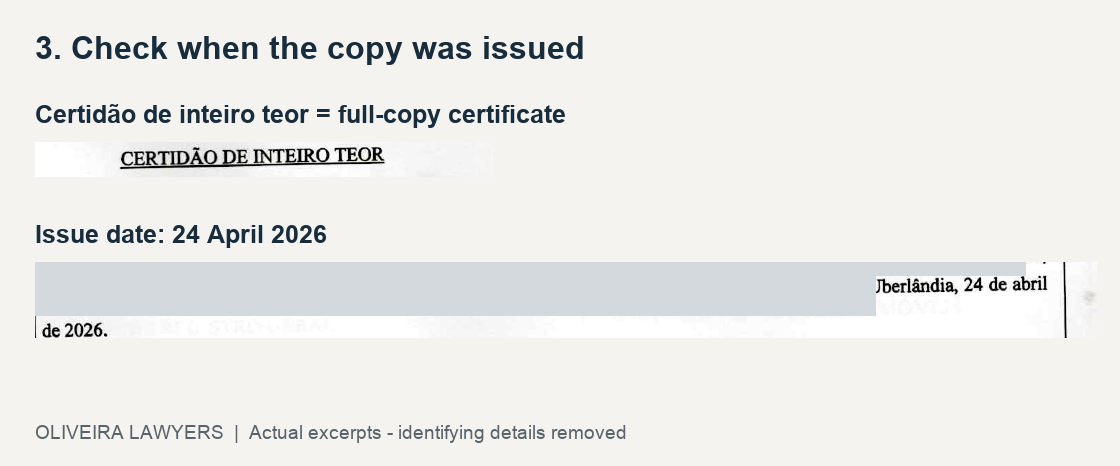
Certidão de inteiro teor means a full-copy certificate. This example was issued on 24 April 2026. That is the copy’s issue date, not the date of every event recorded inside it. A newly issued certificate can contain entries from many years earlier.
On your own certificate, check the issuing registry, all pages and the available signature or validation information. Signatures and verification codes are omitted from these illustrations. An authentic copy can still be out of date for the transaction you are considering.
3. How do I read the matrícula?
Compare the address, unit, area and property description with what is being offered. A parking space or storage unit may have a separate record. Confirm whether the seller owns the whole property or only a share, and whether anyone else must take part in the sale.
Entries marked R record acts such as an ownership transfer or mortgage. Entries marked AV record updates such as a name change, construction or cancellation of an earlier entry. Read them together: an old restriction may have been cancelled, while a later entry may create a new issue. [1]
Example 1: Understanding the entries
A matrícula is the property’s running record. Its opening description is followed by entries recording transactions and changes. These excerpts from an actual apartment record show why you need to read beyond the first page.
Illustrative example — identifying details removed. The grey areas permanently cover information omitted for privacy. These are selected excerpts, not a complete certificate or evidence of the property’s current status. Select any illustration to enlarge it.
Start with the property description and original owner
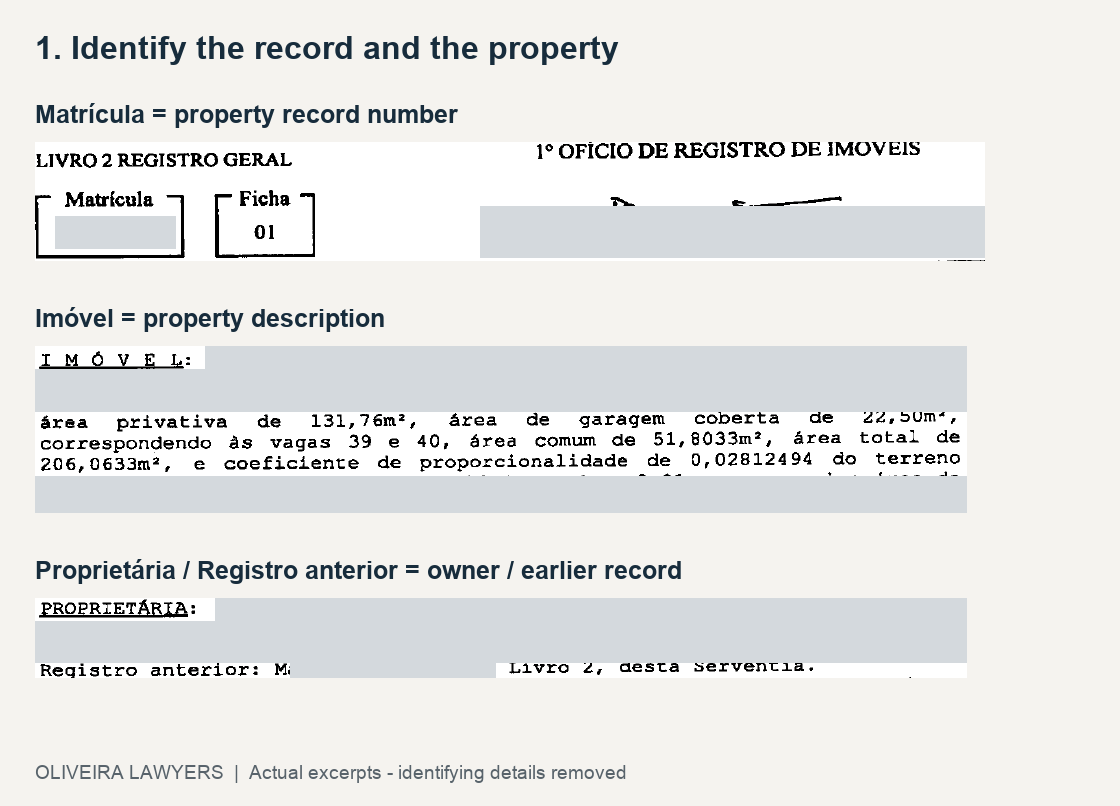
What it means
- Matrícula and Registro de Imóveis: the record number and the registry that maintains it. Use both to identify the correct record. “Ficha” identifies a sheet within the record.
- Imóvel: the property description. For this apartment, it separates the private area, parking area and common area. The total area is not simply the space inside the apartment.
- Proprietária: the owner named when this record was opened. Do not stop here: later entries may record a sale or another ownership change.
- Registro anterior: the earlier record from which this one originated. It points your lawyer to additional history when needed.
Then follow the later entries
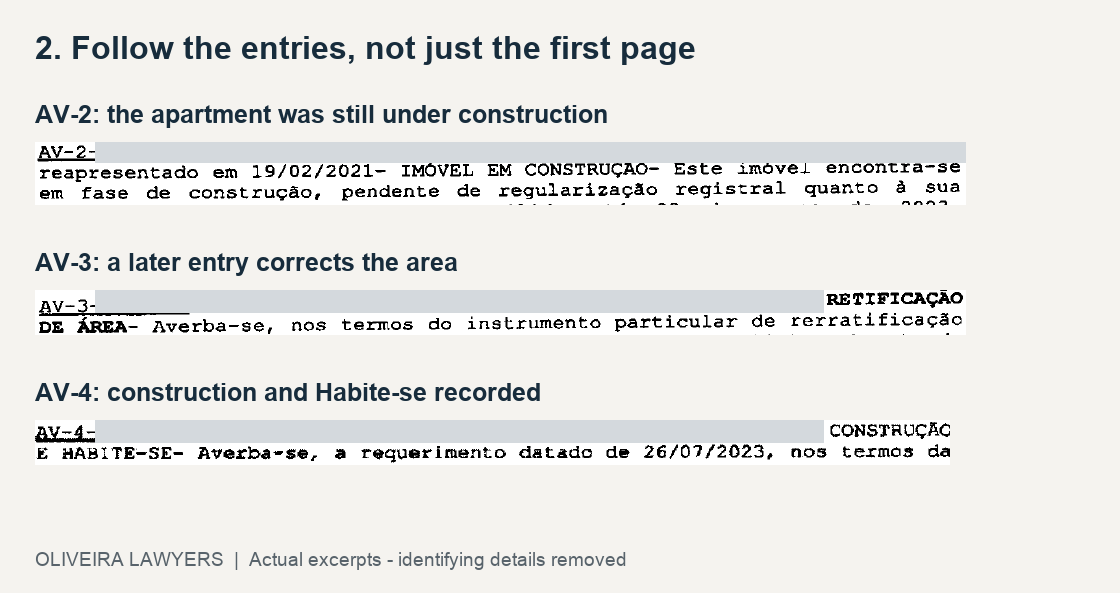
What it means
AV means averbação: an update added to the record. Here, AV-2 describes the apartment as under construction. AV-3 later corrects its area. AV-4 records construction completion and the Habite-se, the municipal document authorizing occupancy.
The earlier text remains visible even after later updates. Reading only the opening description or AV-2 would give you an incomplete picture. Your lawyer must connect the entries and check any documents they refer to.
What this example does not establish
This particular example contains AV entries, but no later entry marked R. As explained above, R entries can record a purchase or mortgage. Neither label alone tells you whether an entry creates a problem; its wording and later entries matter. [1]
Recognizing the sections is only the starting point. This example does not establish that a property is safe to buy. Retain a licensed lawyer in Brazil to review a current, complete record and the other documents your purchase requires.
The entries show how the property has changed. The next example focuses on the transfer that identifies its owner.
4. Who owns the property now?
Find the latest registered transfer
The owner named at the top may no longer own the property. Find the latest entry that transfers ownership, identify who acquired the property and how much they acquired, then read everything that follows. A later entry may cancel or correct the transfer, or affect the owners’ rights.
Example 2: Following a registered sale
Simplified English explanation of a different property record. Names are replaced with labels; this is not a reproduction of the document.
The developer appears as the original owner.
The developer sold the property to Buyer A, identified as married to Spouse B under the universal community property regime.
The next entry confirms the couple’s marital-property regime. It does not record another sale.
What it means: R-5 is the latest sale in the copy reviewed. Ownership has moved from the developer to the buyer under the stated marital regime. Do not treat Buyer A as the sole owner or ignore Spouse B: the couple’s property rights must be read together.
What this example does not establish
The latest entry and the latest sale are not necessarily the same. A sale of only a share also does not make the purchaser the sole owner. Inheritance, gifts and other registered transfers may change ownership without a sale. Your lawyer should confirm the current owners, their shares and who needs to sign using an up-to-date, complete certificate. [2]
The recorded sale tells you who acquired the property. Next, check whether another document is waiting to be registered.
5. Could something still be pending?
A pending filing: prenotação
When ordering a fresh certificate, you may receive a warning that there is a prenotação: a document has been formally filed with the registry, but the requested registration or update is still pending. It could be a new sale, a mortgage or another change that does not yet appear as a completed entry in the matrícula. How this warning is presented can vary.
A sale waiting to be registered: the matrícula still shows Seller A, but a Deed transferring the property to Buyer B has already been filed and is awaiting registration. The pending filing is not the same as a completed sale registration, but it may have priority over a document filed later. [1]
Do not assume the property is available simply because the old owner’s name is still there. Before you sign or pay, have your lawyer ask what was filed, when it was filed and whether it is still pending. The filing may be registered, require corrections or lose its effect; the outcome should not be guessed. Obtain confirmation from the registry and an updated certificate when appropriate. [8]
A reference to an old protocol number inside a completed entry is not, by itself, a warning of a pending filing. The question is whether there is an active prenotação that has not yet been resolved.
6. What else needs checking?
Restrictions recorded in the matrícula
A mortgage, court restriction or usufruct (“usufruto”) needs individual attention. Usufruct can allow someone other than the owner to use the property and receive its income. An entry does not always make a purchase impossible, but your lawyer should establish what must be released, cancelled or otherwise addressed before you commit. A seller’s promise to “sort it out later” is not enough.
Checks beyond the matrícula
There are many checks that are required when buying properties in Brazil. Some of them are done at this first stage, while others may need updating later. Do not assume it is safe to pay a downpayment before the essential checks. Your lawyer should identify what must be resolved before you sign or pay. Some of the checks done at this early stage are related to:
- Buyer documents, including identity and authority to sign.
- Development and construction, including whether the documents match what was built.
- Zoning and building rules, including whether the intended use is permitted.
- Usufruct and other rights affecting use of the property.
A record with no listed restriction does not prove that property taxes or condominium charges have been paid. These debts can become the buyer’s responsibility. Nor does the record alone confirm who occupies the property, the condition of the building or every problem involving the seller. See the separate guides to property certificates and seller certificates. [2, 6]
Brazilian law gives important protection to buyers who act in good faith and rely on the registry. It also means that court-search certificates are not a universal legal requirement for every covered purchase. That does not make every property safe to buy without further investigation. Your lawyer should decide which additional checks your transaction needs. [7]
As with any property transaction or research, it’s essential to consult directly with the appropriate local authorities or legal experts. If you need an assessment of the purchase risks beyond obtaining records, see our real estate due diligence service.
Watch our video
If you would rather not coordinate these checks yourself, our property purchase support in Brazil can cover the agreed legal work from the initial checks through registration.
Sources supporting this guide
Official sources checked on 21 October 2026. Numbers in the text refer to this table.
| Source | What it supports |
|---|---|
| [1] Public Records Law | Law 6,015/1973, arts. 19, 167, 169, 176, 182–188, 205–206 and 232. Registry certificates, location, record contents, the R and AV labels, and the filing, priority and expiry of prenotações. Art. 19 sets specific certificate deadlines; these are not a timetable for the entire purchase investigation. |
| [2] Civil Code | Arts. 108 and 1,245 distinguish the Public Deed and registration; art. 1,345 addresses condominium debts; art. 1,394 describes usufruct rights. |
| [3] ONR | Official description of the national electronic real estate registry operator and its services. |
| [4] RI Digital online record view | Official Visualização de Matrícula manual. The viewing product does not have the legal status of a certificate. |
| [5] RI Digital certificate | Official Certidão Digital manual. Certificate types, digital signatures, validation and ordering. |
| [6] National Tax Code | Art. 130 addresses property-related tax debts passing to buyers, subject to its conditions and exceptions. The guide says these debts can pass, not that every debt always does. |
| [7] Protection for good faith buyers | Law 13,097/2015, art. 54. Registry-based protection and the rule on additional certificates for covered transactions; exceptions remain. |
| [8] STJ: pending prenotação and loss of its effects | STJ explanation published 27 November 2024. Shows why the status and continuing effects of a pending filing matter; a prenotação is not the same as a completed registration. |