

Inheritance & Probate Lawyers in Brazil

Reviewed by Luciano Oliveira, LL.M., attorney admitted in Brazil, Texas, and California. Updated October 23, 2026.
When someone dies leaving assets in Brazil, their heirs may need a Brazilian probate procedure—known as inventário—to identify the estate, address debts and taxes, and transfer ownership. If you live abroad, the work also involves documents, representation, and coordination across countries.
Oliveira Lawyers assists foreign heirs and families with Brazilian estate administration, inheritance disputes, asset searches, and the steps needed to receive their inheritance abroad. We explain your position in English and help you understand what needs to happen next.
Whether your family agrees on the distribution or you are concerned about your share, we can assess the Brazilian side of the matter and the assistance you need.
This page provides general information about inheritance and probate in Brazil. It is not legal advice, and reading it does not create a lawyer–client relationship.
How can we help with your inheritance?
You may be starting a new estate proceeding, trying to understand one already underway, or dealing with a disagreement that needs independent attention. The right starting point depends on what has happened and what you need to accomplish.
Administer an estate
A relative left property, funds, or company interests in Brazil. You need to identify the required documents, choose the appropriate probate route, and complete the distribution.
Protect your inheritance
You have been excluded, asked to sign documents you do not understand, or given an asset list you cannot verify. You need advice focused on your own position.
Find assets or estate records
You need to establish whether there is a will, identify assets, or review information about property, companies, or accounts.
Receive your inheritance abroad
You need to complete ownership transfers, address inherited business interests, sell property where appropriate, or prepare the documentation for an international remittance.
For foreign estate lawyers, executors, and fiduciaries, our Brazil probate and estate administration service explains how we coordinate the Brazilian work with an overseas estate.
When Brazilian probate may be needed

If you live outside Brazil and recently learned that you may inherit property, bank funds, company shares, or other assets in Brazil, the process can feel opaque. You may be asked to sign a Brazilian power of attorney, rely on relatives who already control the assets, or accept an asset list you cannot verify.
For foreign heirs, the practical challenges can include distance, language, documents, asset control, and receiving the proceeds in another country.
A foreign probate order, U.S. estate plan, or family agreement may be relevant, but it does not by itself transfer title to Brazilian real estate. Other Brazilian assets also require the appropriate local documentation and release or transfer procedures. Some situations permit simplified procedures; the assets and circumstances need to be assessed before deciding what must be filed.
Court or notary?
Brazilian probate may proceed through court or, when the requirements are met, through a notary procedure known as extrajudicial inventory. Agreement among heirs is important, but it is not the only condition. The existence of a will, the participation of minors or legally incapacitated heirs, and the proposed distribution all require attention.
The CNJ rules allow certain notarial inventories involving wills or minors and incapacitated heirs, subject to specific safeguards and requirements. Neither circumstance should be treated as an automatic answer about the route. A dispute or failure to meet the notarial conditions may require court proceedings. Source: CNJ Resolution 35, as amended.
See how the probate process works in Brazil and whether foreign citizens can inherit Brazilian property.
What we handle
We define the scope around the estate and the person or parties we represent. An agreed administration and a contested inheritance may involve many of the same records, but they need different strategies.
- Initial assessment: review the family relationships, known assets, will, existing proceedings, and any immediate concern about the estate.
- Representation and documents: identify the powers of attorney, certificates, CPF records, apostilles, and translations needed for the matter.
- Asset verification: review property and corporate records and seek estate information through the procedures available in the case.
- Probate administration: conduct the appropriate court or notarial steps and coordinate the documents needed for distribution.
- Disputed inheritances: assess exclusion, concealment, contested documents, administrator conduct, and other threats to an heir’s position.
- Completion: coordinate applicable tax documentation, ownership registrations, asset releases, and any separately agreed sale or remittance work.
An asset search is not a promise that every asset can be found. Access to banking and other protected information depends on the estate, the authority to request it, and any court or institutional requirements.
The probate process when you live abroad
Most foreign heirs experience the process in stages. Some steps can run together; a dispute, missing document, or title problem may need to be resolved before the next one can proceed.
- Understand the estate. Identify who died, the family relationships, the known assets, and whether probate has already started in Brazil or elsewhere.
- Prepare your representation and documents. Establish who the lawyer represents and which documents and powers are needed. Review any proposed waiver, agreement, or power of attorney before signing.
- Identify assets and obligations. Check the available property, company, banking, debt, and will information. Investigate inconsistencies where necessary.
- Determine and conduct the appropriate procedure. Assess whether the matter qualifies for a notarial inventory or needs court proceedings, then address the required filings and decisions.
- Resolve taxes and distribution. Coordinate the applicable inheritance-tax requirements and the documents establishing how the estate will be divided.
- Complete registrations and releases. Address the relevant property registries, banks, and corporate records. Coordinate any agreed sale or transfer abroad.
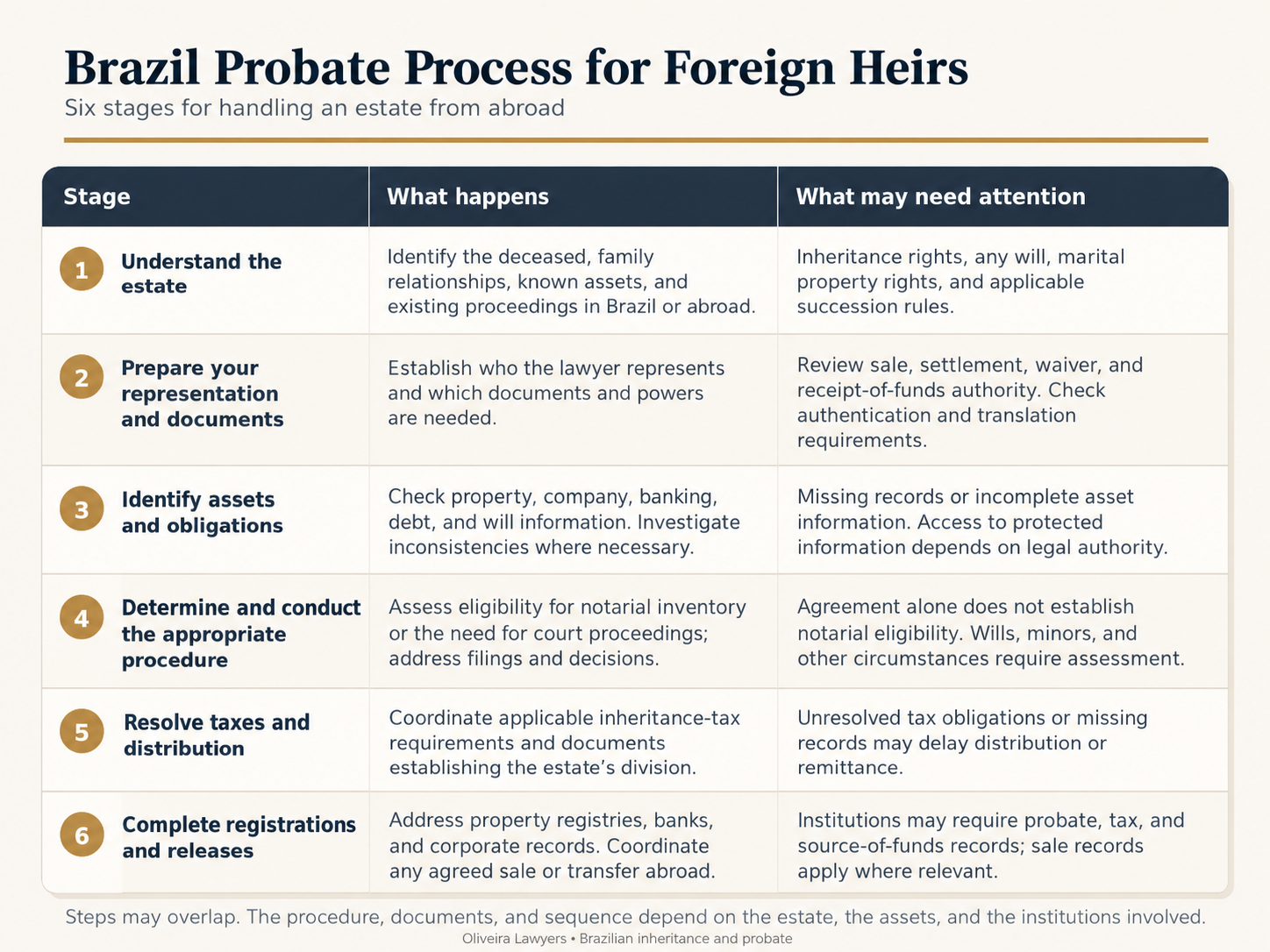
Living abroad does not necessarily mean you must travel to Brazil. Many steps can be handled through appropriately documented representation. The form of the power of attorney and any personal participation depend on the act and the requirements of the court, notary, registry, or bank.
Start with the inheritance document checklist and our guide for heirs who cannot attend Brazilian proceedings.
Protecting your share of the estate

Sometimes joint representation works. When heirs agree and their interests are aligned, a coordinated approach can help an estate move forward. But foreign heirs should be careful when local relatives already control the information, the assets, or the pace of the probate.
A local heir may be living in the property, collecting rent, or managing a business. A foreign heir usually has less visibility, less access to documents, and less practical ability to check what is happening in Brazil. Those circumstances do not establish wrongdoing, but they make clear records and a defined scope of authority particularly important.
Before signing a power of attorney or distribution agreement
Ask what you are authorizing and who will act for you. Powers to sell, settle, waive rights, approve a partition, or receive funds should be understood before they are granted. Where interests diverge, an independent lawyer can review the asset list, court docket, proposed partition, and any relevant company records.
Issues that deserve attention include:
- Assets or income omitted from the estate information.
- A proposed sale or distribution that has not been explained or documented.
- Company amendments, dilution, or withdrawals that may affect inherited interests.
- Unexplained delay, withheld records, or pressure to renounce or settle cheaply.
If heirs disagree, the matter may require inheritance dispute litigation. Changing your own lawyer is a different issue from challenging the estate administrator; the available steps depend on who is responsible and what the records show.
Being abroad does not, by itself, remove your inheritance rights

A parent may have moved to Brazil, formed a new family, and acquired assets there. Children abroad may have had little contact for years. That emotional distance does not automatically erase inheritance rights.
Where Brazilian forced-heirship rules apply, the Civil Code protects necessary heirs and reserves half of the inheritance as the legítima. Who receives a share and how it is calculated depend on the family structure, applicable succession law, marital property rights, debts, and relevant lifetime transfers. A protected half is not a promise that each child receives half of every asset. Source: Civil Code, articles 1,845–1,847.
See Brazil’s forced-heirship rules, choosing your own probate attorney, and locating missing estate assets.
Costs, timing, and what affects progress
Timing depends on whether the probate is judicial or extrajudicial, whether heirs agree, whether documents are ready, whether taxes are resolved, and whether assets are disputed. An agreed estate with complete records usually involves fewer obstacles than one with contested heirs, missing assets, or unresolved property ownership.
The work may include professional fees, inheritance tax, notary or court charges, registry fees, translations, apostilles, and appraisals. A property sale or international remittance can add separate work and expenses. These should be distinguished in the engagement scope rather than treated as one unexplained “probate cost.”
We assess the available information before estimating our professional fees. If the matter changes—for example, an agreed administration becomes disputed—the scope and fee arrangement may also need to be reviewed.
Starting promptly helps identify time-sensitive filings and tax obligations. It does not mean accepting an incomplete inventory or signing documents under pressure. The right next step may be gathering records, opening the proceeding, or seeking protection for an asset.
Read about inheritance taxes and fees, inheritance deadlines, and urgent circumstances and delays.
Receiving your inheritance
A distribution document is an important milestone, but further steps may be needed before you can use an asset or receive its proceeds. Property, bank funds, and company interests each have their own transfer requirements.
Selling inherited property
The sale must be coordinated with the probate, title transfer, tax treatment, and foreign exchange documentation. In many cases, inherited real estate must first be addressed in the probate or through legally authorized estate procedures before a clean sale can occur.
A sale before the inventory is completed is possible only through an applicable legal route and subject to its requirements. It should not be assumed that an agreement among relatives, by itself, is enough. We can assess the sequence and coordinate with the professionals involved in an agreed sale.
Transferring funds abroad

A remittance commonly requires a clear paper trail showing the heir’s identity, the probate or distribution documents, applicable tax records, and the lawful source of the money. Where property has been sold, the sale and registry records may also be relevant. The bank or exchange institution determines the documentation required for its checks.
International transfers should be arranged through an appropriate authorized institution. We assist with the legal documentation and coordination; the financial institution executes the transfer and applies its own compliance requirements. Source: Central Bank of Brazil, international transfers.
Read about transferring inherited funds abroad, whether a separate Brazilian bank account is needed, and inheriting company shares.
Inheritance and probate resources
Use these guides to explore the part of the process that concerns you. They provide background; the documents and facts of your estate determine how the rules apply.
Understand your rights
Prepare from abroad
Complete the probate
Find and protect the estate
Receive or manage assets
Practical questions and specialist reading
Working with Oliveira Lawyers
We begin by understanding your relationship to the estate, where its assets are located, what has already been done, and what you need from Brazilian counsel. If a proceeding is underway, the existing file and the documents you have been asked to sign can be especially useful.
The engagement should make clear who we represent, the work included, the professional-fee arrangement, and the documents needed to proceed. Throughout the matter, we explain the Brazilian steps in English and coordinate with your overseas advisers where the engagement calls for it.
For foreign lawyers and fiduciaries, our probate and estate administration page addresses professional coordination. If you are arranging your affairs during life, our Estate Planning practice is the appropriate starting point.
Frequently asked questions

1. Can a foreign citizen inherit assets in Brazil?
Yes. Foreign nationality does not by itself prevent inheritance. Entitlement, the assets involved, and the documents needed for transfer must still be assessed. Brazilian probate, tax identification, and translated or authenticated records may be required.
2. Do I need Brazilian probate if an estate proceeding already exists abroad?
Often, local estate steps are still needed. A foreign proceeding does not by itself transfer Brazilian real estate. Your lawyer should examine the assets and foreign documents to determine which Brazilian procedure applies.
3. Do I need a Brazilian lawyer?
Brazilian court representation and notarial probate require appropriately qualified legal assistance. Your lawyer abroad can coordinate with Brazilian counsel, but an overseas qualification alone does not authorize practice in Brazil.
4. Can I handle the matter without traveling?
Many steps can be completed through representation. The necessary power of attorney, identification, and signing procedures depend on the acts involved. A court, notary, registry, or bank may require additional participation or verification.
5. What documents will I need?
Common starting documents include the death certificate, identification and family-status records, asset information, and any will or existing probate documents. Foreign records may need apostilles or other authentication and sworn translations. The checklist is tailored to the estate.
6. When can probate proceed through a notary?
When the estate meets the legal requirements for an extrajudicial inventory. Agreement among heirs is important. Wills, minors, and legally incapacitated heirs require additional analysis and safeguards under the applicable rules; a notary route should never be assumed solely because the family agrees.
7. How long does probate in Brazil take?
There is no reliable single completion time for every estate. The route, document readiness, tax issues, registries, and any dispute all affect progress. An initial assessment can identify the principal obstacles and the stages likely to require the most work.
8. What costs should I expect?
Professional fees are separate from applicable taxes and third-party expenses, which can include court or notary charges, registry fees, translations, apostilles, and valuations. Request a scope-based estimate and identify whether sale, litigation, or remittance assistance is included.
9. Does a foreign will determine who receives Brazilian assets?
A foreign will may be relevant, but its form, effect, applicable succession law, and the procedures for using it in Brazil must be reviewed. It does not automatically establish a transferable Brazilian title or resolve every protected-heir issue.
10. How can forced heirship affect my share?
Where Brazilian forced-heirship rules apply, a reserved portion protects necessary heirs. The calculation depends on the estate and family circumstances. Marital property ownership must also be distinguished from inheritance; they are not the same entitlement.
11. Can I use the same lawyer as the other heirs?
Sometimes, where interests are aligned and joint representation is appropriate. If there is disagreement, incomplete disclosure, or pressure to sign, separate advice may be needed. Establish clearly who the lawyer represents before relying on their advice.
12. What should I check before signing a power of attorney?
Check who may act, which acts are authorized, and whether the document permits sale, settlement, waiver, partition, or receipt of funds. Do not assume that every probate power of attorney has the same scope.
13. What if assets are missing or another heir controls them?
Legal counsel can review estate filings and available registry or company records, and assess requests for disclosure or protective measures. Suspicion alone does not establish concealment; the response depends on evidence and the procedures available.
14. Can I sell inherited property?
Often yes, once the appropriate authority, ownership, and transaction requirements are addressed. A sale before probate is complete needs a legally available route. Coordinate the probate, registration, taxes, and sale documents before committing to a transaction.
15. Can I receive inheritance proceeds abroad?
Generally, lawful proceeds can be remitted with the required documentation and compliance checks. The institution handling the transfer may request probate, applicable tax, and source-of-funds records, plus sale records where relevant. Receiving-country reporting should be discussed with your adviser there.
16. Can you coordinate with my lawyer or executor overseas?
Yes. We can address the Brazilian work and coordinate with the professionals handling the foreign estate, within an agreed scope. The engagement should identify responsibilities and the documents each jurisdiction requires.
Discuss your Brazilian inheritance matter
If you need advice about your rights, documents, or next steps, book a probate consultation. If you want an estimate for defined legal assistance, send a brief description of the estate and the service needed.
Send a service inquiry
Tell us what you need. Our team will reply by email about scope and fees.
Every estate is different. This page is general information, not legal or tax advice, and does not promise a particular result. Advice on your situation requires a formal consultation and review of the relevant facts and documents by a lawyer qualified in the applicable jurisdiction.