

Hiring a Law Firm in Brazil as a Foreign Client

Oliveira Lawyers is a Brazilian law firm designed for people, families, companies, and professional advisors who need legal work handled in Brazil while they are located abroad. Many clients come to us because they are not only looking for a law firm in Brazil. They are looking for a firm that can explain the Brazilian system clearly, communicate in English, coordinate documents across borders, and deliver legal work in a format that makes sense to international clients.
Oliveira Lawyers is the website for Navas Oliveira Advogados, a law firm registered with the São Paulo section of the Brazilian Bar Association.
The firm’s foreign-client practice was founded in 2004 in connection with a U.S.-Brazil litigation matter. Luciano Oliveira, the firm’s managing partner, is admitted in Brazil, Texas, and California, and the firm’s cross-border work is structured around the needs of clients managing Brazilian legal issues from abroad.
On this page, our goal is to help foreign individuals, businesses, and counsels select a reputable law firm in Brazil.
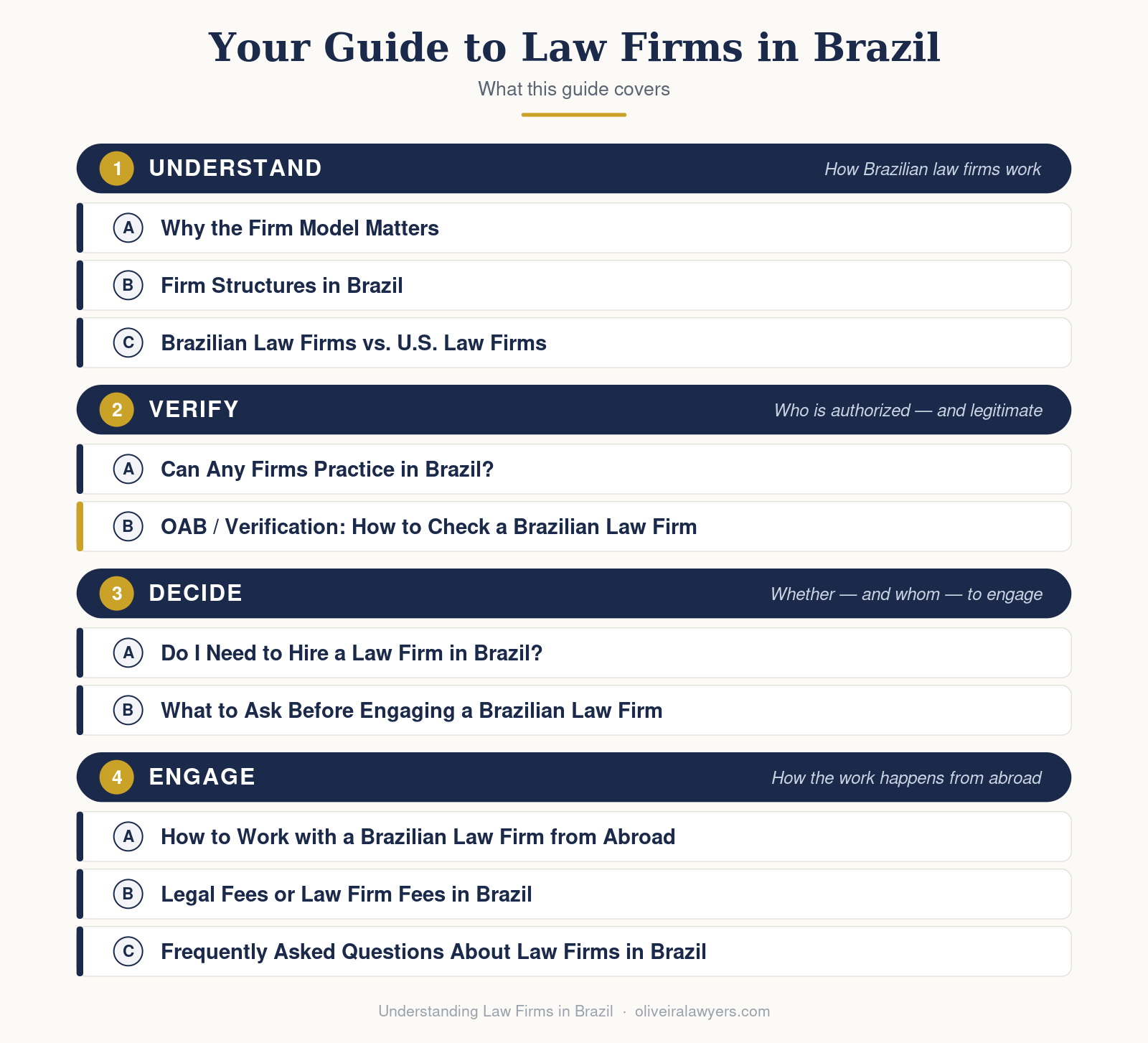
Many foreign clients approach Brazil with assumptions formed in their own legal systems. A U.S. client may expect a law firm to be organized as a large multi-state partnership. A British client may expect a solicitor-style model. A European client may expect a civil-law practice but may still be surprised by the Brazilian role of the OAB, cartórios, public registries, sworn translations, apostilles, and formal powers of attorney.
A Brazilian law firm exists within a regulated professional environment. The practice of law in Brazil is governed by the Estatuto da Advocacia e da OAB, Law No. 8.906/1994. That statute treats judicial representation and legal consulting, advisory, and legal direction activities as activities reserved for the legal profession. It also provides that the exercise of advocacy in Brazil and the title of advogado are reserved to those registered with the OAB.
In Brazil, the professional identity of the firm, the registration of the professionals, the scope of permitted services, and the ethical rules on advertising and fees are all connected to OAB regulation.
1. UNDERSTAND
A. Why the Firm Model Matters
The word “firm” can hide very different realities. Some law firms in Brazil are small, partner-led offices with a narrow practice focus. Others are large full-service firms serving corporate and institutional clients. Some are boutique practices organized around litigation, tax, M&A, real estate, immigration, family wealth, or foreign-client work. Some are domestic-first firms that occasionally handle international clients. Others, like Oliveira Lawyers, are structured from the beginning around cross-border representation.
For example, a foreign individual buying an apartment in Rio de Janeiro may need real estate due diligence, registry review, CPF coordination, a closing structure, power of attorney formalities, money-transfer guidance, and English explanations of Brazilian title risks. A foreign company entering Brazil may need contract review, entity formation, local regulatory analysis, employment coordination, and tax/accounting interfaces. A foreign heir may need probate representation, document legalization, sworn translation, estate inventory, tax coordination, and fund repatriation. A foreign law firm may need legal opinions, expert declarations, local filings, litigation monitoring, or evidence-gathering support.
All of these clients may search for a law firm in Brazil, but they do not all need the same kind of firm.
B. Firm Structures in Brazil
A Brazilian law firm is commonly organized as a sociedade de advogados (“association of attorneys”) or, in the case of a one-member structure, a sociedade individual de advocacia (“individual association of advocacy”). These structures are not ordinary commercial companies in the way many foreign clients think of a company. They are professional legal entities tied to the practice of law and subject to the rules of the OAB.
Brazilian law also restricts the mixing of legal practice with most non-legal commercial activities. Under the Estatuto da Advocacia, legal consulting, advisory, and legal direction activities are among the activities reserved to advocacy, and the statute also restricts the practice of advocacy to those registered with the OAB.
This creates a professional environment where a law firm in Brazil is not supposed to operate like an investment consultancy or general business intermediary. Those other professionals may be essential in a cross-border matter, but they are not the same as a Brazilian legal practice.
A strong cross-border firm often coordinates with those other professionals while keeping the legal role distinct. For example, a real estate acquisition may involve a broker, bank, currency exchange provider, notary office, property registry, accountant, and tax advisor. A probate may involve foreign counsel, estate advisors, translators, banks, courts, tax authorities, and registry offices. The legal firm’s role is to identify the Brazil-side legal risks, structure the legal steps, prepare or review documents, represent the client where appropriate, and coordinate legal requirements with the broader transaction.
This is also why a bilingual law firm can add value beyond translation. The issue is not merely converting Portuguese words into English. The issue is explaining how Brazilian matters and legal concepts work using references that are meaningful to a non-Brazilian.
C. Brazilian Law Firms vs. U.S. Law Firms
Foreign clients often assume that Brazil law firms operate like U.S. law firms with Portuguese documents. That assumption can create confusion.
The first major difference is the brazilian legal system itself. Brazil is a civil-law country. The legal system in brazil therefore works differently from a common-law system such as the United States. U.S. clients are used to a legal culture where precedent, discovery, depositions, motion practice, settlement leverage, and court-created doctrines play a central role. Brazil also has case law, binding precedent mechanisms, constitutional courts, and sophisticated litigation, but codified law and statutory procedure remain central to the way legal analysis is framed.
That difference affects law-firm work.
In a U.S. matter, a client may expect extensive discovery, adversarial document production, broad depositions, and legal analysis organized around precedent. In a Brazilian matter, there is almost no autonomous discovery and the analysis may focus more heavily on codes, statutes, procedural rules, registry records, documentary evidence, court-appointed experts, notarized or apostilled documents, and formal acts before public or quasi-public offices.
Public registries known as “cartorios” have an important role in Brazil. In many Brazil matters, the decisive step may not be a court filing. It may be a registry act, a notarial deed, a sworn translation, an apostilled document, a power of attorney accepted by a Brazilian notary or registry, a tax registration, or a government-system update. Clients coming from the U.S. often underestimate these formalities because they do not map cleanly onto U.S. practice.
Communication also matters. Many domestic law firms in Brazil are used to clients who understand the local system, speak Portuguese, and can appear locally when needed. Foreign clients often require a different workflow: written explanations in English, clear document lists, time-zone planning, scanned document review, international courier coordination, foreign notarization and apostille guidance, and coordination with non-Brazilian counsel.
Another difference is billing culture. U.S. clients may expect hourly billing in many legal matters. Brazilian matters may involve flat fees, staged fees, monthly retainers, hourly billing, success fees, or combinations of these structures. The best structure depends on the predictability of the work, the matter type, and professional rules.
A bilingual law firm operating between Brazil and the U.S. must understand both sides. It must know Brazilian law and procedure, but also know how foreign clients expect a legal engagement to be explained, documented, staffed, and reported.
2. VERIFY
A. Can Any Firms Practice in Brazil?
Foreign clients often ask whether foreign firms can simply operate in Brazil. They may search for american law firms in brazil, foreign law firms in brazil, international law firms in brazil, or law firms with offices in brazil. The better question is not whether a foreign brand has a Brazil presence. The better question is what that office, consultant, affiliate, or local partner is legally authorized to do.
Under OAB Provimento No. 91/2000, a foreign legal professional admitted abroad may provide services in Brazil only after authorization by the OAB, and that authorization is limited to consulting on the foreign law of the country or state of origin. The same rule expressly prohibits judicial representation and consulting or advising on Brazilian law under that foreign-consultant authorization (PDF version of the regulation).
A U.S. lawyer is not automatically authorized to practice Brazilian law merely because they are licensed in a U.S. state. A U.S. license may be highly valuable in a cross-border matter, especially where U.S. law or facts are involved. But Brazilian-law advice, court representation, and legal acts reserved to Brazilian advocacy require the appropriate Brazilian authorization.
This distinction also matters when comparing international law firms in Brazil with Brazilian firms that handle cross-border work. Some international firms may have consultant structures, cooperation arrangements, referral networks, or affiliated local practices. Others may work through Brazilian firms for local-law advice. The practical question is always: who is actually advising on Brazilian law, signing the work product and appearing before Brazilian authorities?
For a foreign client, the safest approach is to avoid relying on branding alone. A foreign-sounding name, a U.S. office, a London connection, or an English-language website does not by itself answer the authorization question. Conversely, a properly registered Brazilian law firm with U.S.-admitted leadership or cross-border experience may be better positioned for certain matters than a large foreign brand that must still rely on local Brazilian counsel for the Brazil-law component.
B. OAB / Verification: How to Check a Brazilian Law Firm
Before engaging any law firm in Brazil, foreign clients should understand the role of the OAB. The OAB is the Ordem dos Advogados do Brasil, often described in English as the brazilian bar association. It is the national institution responsible for the representation, selection, and discipline of the legal profession in Brazil throughout Brazil.
People searching oab brazil are usually trying to answer a practical question: “How do I know whether this person or firm is legitimate?” That question is especially important for clients outside Brazil because many Brazil-related transactions involve intermediaries: brokers, despachantes, consultants, family contacts, translators, accountants, banks, and document facilitators. Some may be helpful, but they are not substitutes for legal registration.
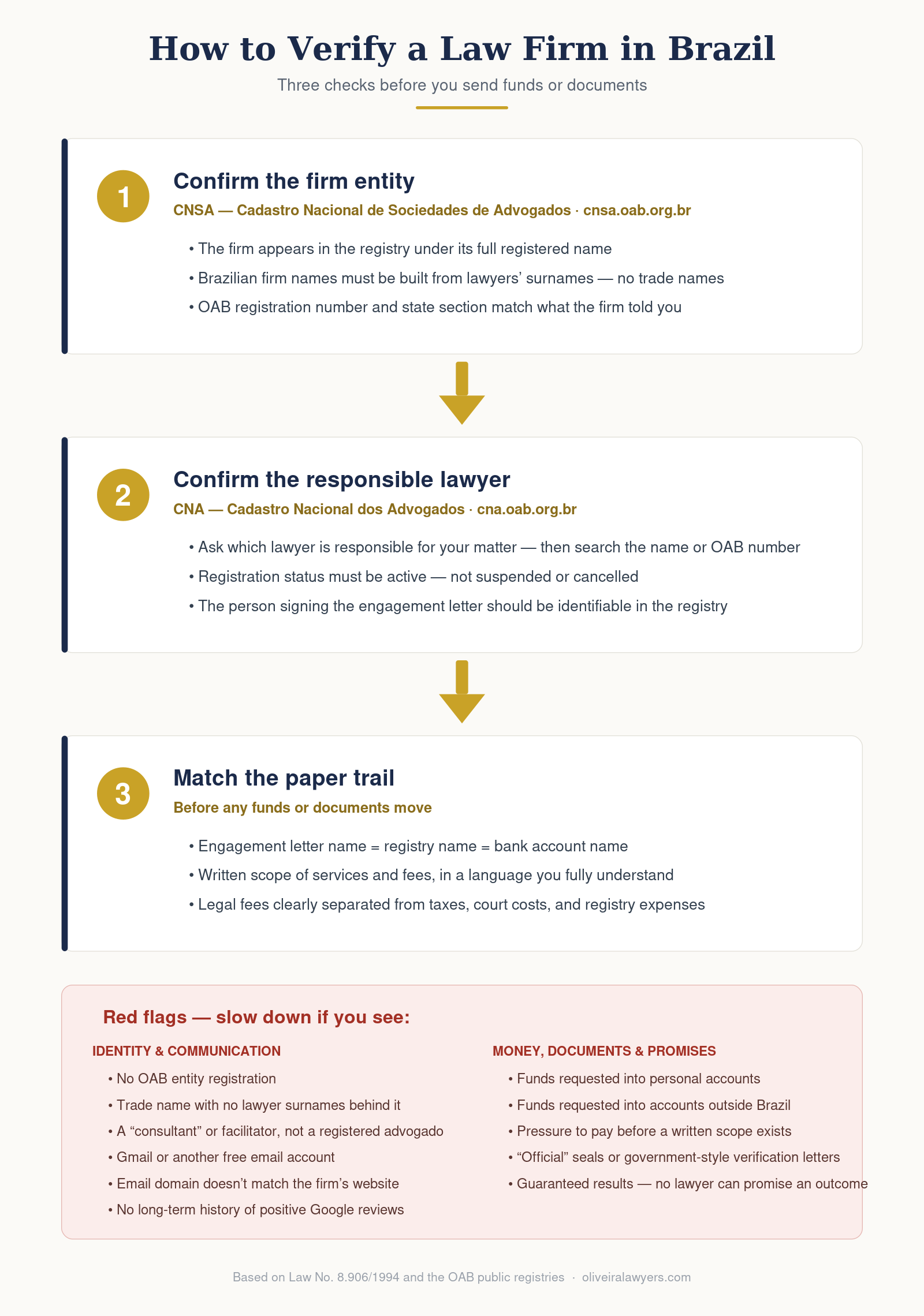
There are two main checks a foreign client may consider.
You can check yourself through these two databases by accessing them using a Chrome browser and right-clicking on your mouse to machine translate the content to English. The images below represent the already Chrome-translated versions of the registries. Note that the original pages are actually in Portuguese and offer no version in English.
Checking an individual Brazilian Attorney
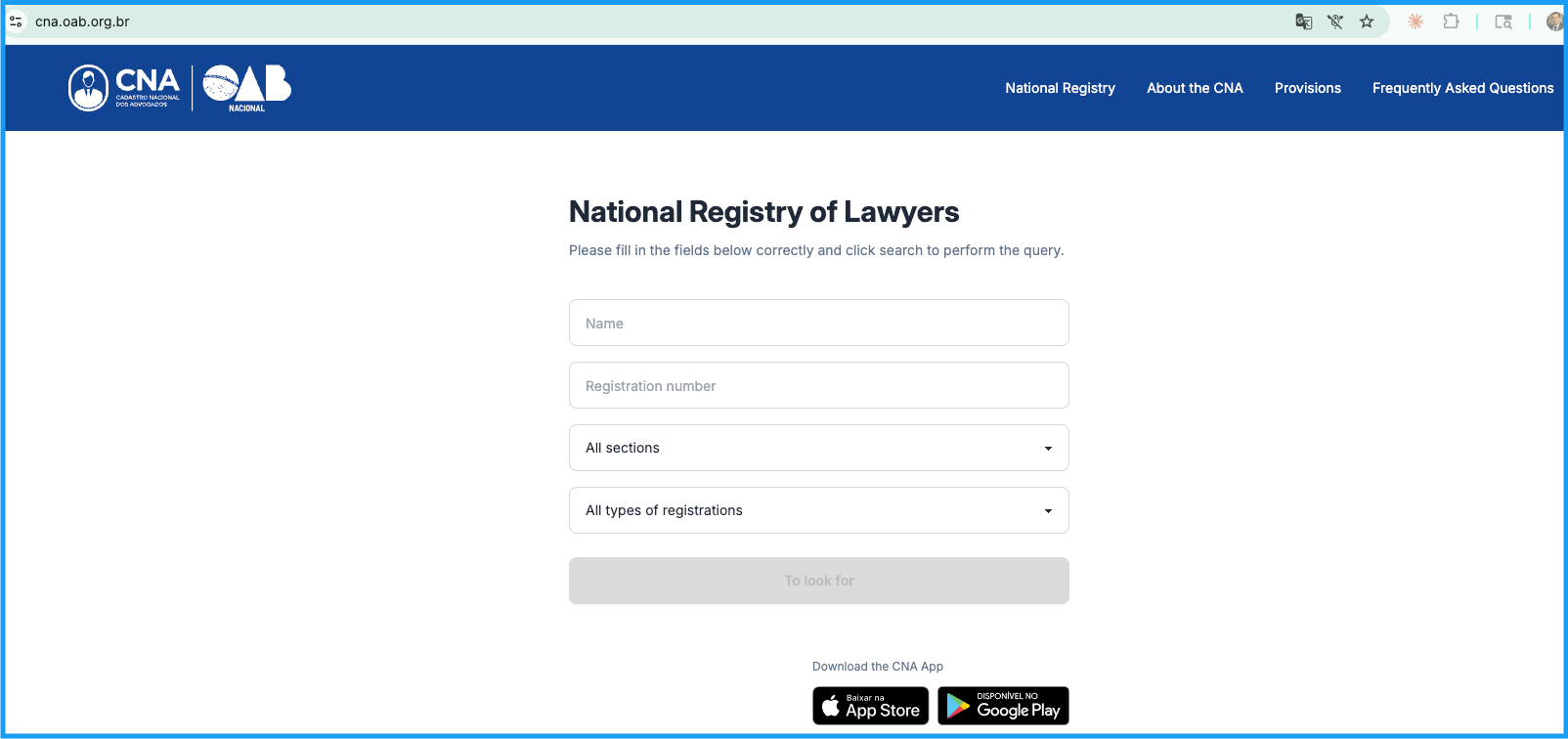
The first is the individual professional check. The OAB’s Cadastro Nacional dos Advogados, or CNA, allows users to search for registered legal professionals by name, registration number, or location.
To access the individual attorneys registry: https://cna.oab.org.br/
Checking a Brazilian Law Firm
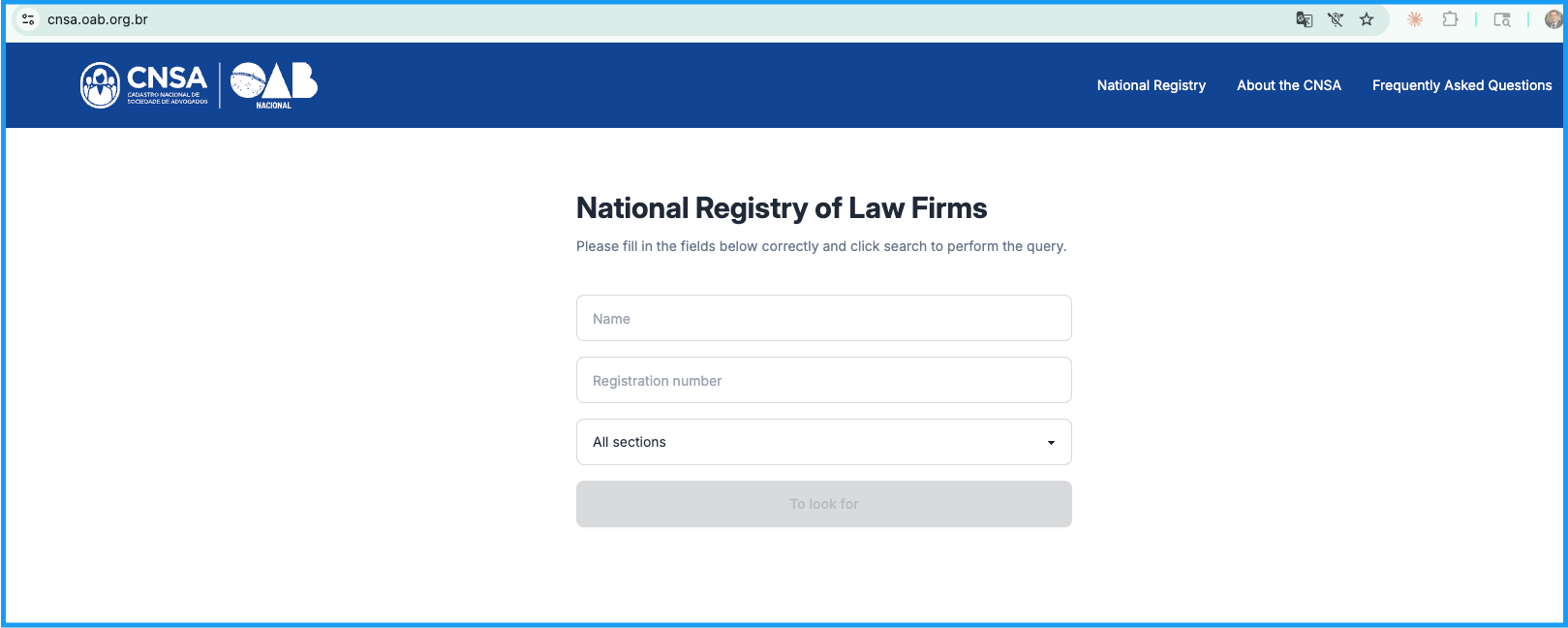
The second is the firm check. The Cadastro Nacional de Sociedade de Advogados, or CNSA, allows users to search for registered Brazilian law-firm entities.
To access the law firms registry: https://cnsa.oab.org.br/
When verifying Brazilian law firms, it is useful to check both levels. A firm may have a registered professional entity, and the professionals working on the matter should also have individual OAB registrations. For a sociedade de advogados or sociedade individual de advocacia, the firm’s name and registration should align with OAB records. For individual professionals, the name, OAB number, and status should be reviewed.
A practical verification checklist includes:
- Confirm the full legal name of the firm.
- Search the firm in the national law-firm registration database.
- Search the responsible professionals in the individual lawyer database.
- Confirm the OAB state section and registration number.
- Ask who will sign the engagement letter and who will be responsible for the work.
- Request a written scope of services before sending funds or documents.
- Distinguish legal fees from taxes, court costs, registry expenses, translations, courier fees, and third-party professional fees.
- Know that Gmail or other free accounts are not typically used by law firms in Brazil. The vast majority of Brazilian law firms will never ask you to pay to a bank account outside of Brazil
This is not only about fraud prevention. It is also about clarity. A legitimate Brazilian law firm should be able to explain who it is, how it is registered, who will handle the matter, what the scope is, what the fee covers, and what costs are outside the firm’s fee.
If you are sending purchase funds, signing documents, granting authority through a power of attorney, entering litigation, inheriting assets, or making an investment, you should know exactly which law firm in Brazil is responsible for the legal work.
3. DECIDE
A. Do I Need to Hire a Law Firm in Brazil?
Many foreign clients ask, “do i need a law firm in brazil?” The answer depends on the matter. Not every Brazil-related question requires a full legal engagement. But some situations are risky enough that a foreign client should not rely on informal advice, translation help, a broker, a family contact, or an internet summary.
You should consider using a law firm in Brazil when the matter involves legal rights, property, inheritance, court filings, immigration status, company interests, contracts, tax-sensitive transactions, family-law consequences, or authority granted through formal documents. You should also consider a firm when more than one Brazilian institution is involved, such as a court, registry, notary office, tax authority, bank, immigration authority, corporate registry, or municipal office.
You may not need to hire a firm for a general educational question. You probably do need a Brazilian law firm if you are buying or selling real estate, signing a contract with Brazilian legal consequences, inheriting assets in Brazil, participating in a Brazilian court case, granting a power of attorney, forming or changing a Brazilian company, transferring significant funds, seeking a legal opinion, or dealing with a dispute.
The difference between a casual question and a legal matter is usually consequence. If a mistake could affect ownership, immigration status, litigation rights, inheritance rights, tax exposure, business liability, or the validity of a document, the safer approach is to hire properly registered counsel.
Among Brazil law firms, look for the firm whose model fits your matter. A highly local firm may be right for a domestic dispute. A large corporate firm may be right for an institutional transaction. A cross-border bilingual law firm may be right when the matter must be handled in Brazil but understood, coordinated, and reported abroad.
B. What to Ask Before Engaging a Brazilian Law Firm
Most foreign clients have never hired a law firm in Brazil, and the first conversation tends to be too polite to be useful. These eight questions will tell you more than any brochure.
1. Credentials you can verify independently
Ask for the firm’s full registered name, OAB registration number, and state section — enough detail to run the registry checks described above (CNSA for the entity, CNA for the responsible lawyer). A legitimate Brazilian law firm expects this question and answers it in one email. Hesitation here ends the conversation.
2. Where the money goes
Confirm that payments will be made to a bank account in Brazil, held in the exact name of the firm you just verified. Requests to wire funds to a personal account, a different company, or an account outside Brazil are among the most reliable fraud signals in cross-border legal work.
3. The fee structure — and everything around it
If budget predictability matters to you, ask whether the matter can be quoted as a fixed fee; many Brazilian matters can. Then ask for estimates of what the fee does not cover: apostilles, sworn translations, cartório charges, and taxes can add meaningfully to a matter’s cost. If litigation is on the table, ask the firm to explain your exposure to honorários de sucumbência — the court-awarded fees a losing party pays to the winner’s lawyers.
4. A realistic timeline
Brazilian proceedings run on Brazilian time. A disputed probate can take more than a decade to resolve; commercial litigation is also measured in years, not months. A firm that promises speed in a contested matter is telling you what you want to hear. Ask for a realistic range — best case, typical case, worst case — before you embark on the journey.
5. Verifiable experience in your type of matter
Ask what the firm actually handles day to day and whether they have experience with foreign clients, then verify it the way that works in 2026: a long-term history of positive Google reviews, and presence in reputable directories such as Chambers and the Latin Lawyer 250. One thing you should not expect: client names and case details. Brazilian lawyers are bound by professional secrecy, and OAB rules restrict identifying clients. If someone volunteers other clients’ information to win your business, ask yourself what they’ll do with yours.
6. What is included — and what you’ll be chasing yourself
Most law firms in Brazil do not provide all-inclusive service. The default is to handle the strictly legal core and leave the client to correr atrás — literally “run after” — everything else: translations, certificates, bank appointments, municipal paperwork. That model works fine for clients in Brazil. From abroad, it doesn’t. Get the boundary in writing: what the firm does, what it coordinates, and what lands on you.
7. The team behind the engagement
Ask who else works at the firm, where it operates from, and who covers your matter when the responsible lawyer is in a hearing. An established firm with a real team and infrastructure has a reputation to protect and is structurally less able to take your money and disappear. A nameless solo operation reachable only through a contact form or WhatsApp offers no such assurance.
8. Talk before you sign
Do not engage on the strength of well-written emails alone — polished text is easy to produce nowadays with AI and proves little. Insist on a video or phone call with the lawyer who will actually handle your matter. Five minutes of conversation tells you whether the firm can explain Brazilian procedure to you orally, in English, under questioning — which is exactly what you’ll need from them for the life of the matter.
4. ENGAGE
A. How to Work with a Brazilian Law Firm from Abroad
Most foreign clients do not need to travel to Brazil. Many matters can begin remotely through a consultation, document review, written scope, engagement letter, secure file exchange, and video conference. But remote work does not mean informal work. In Brazil-related matters, the formalities often matter more, not less.
The first step is usually scoping. A competent law firm in Brazil should ask what the matter involves, who the parties are, where the assets or documents are located, what deadlines exist, what documents are already available, and whether there are related proceedings or advisors in another country.
The second step is conflict review and engagement. Foreign clients should expect a written engagement letter or service agreement explaining the scope, fees, payment terms, exclusions, and responsibilities. If the firm will coordinate with brokers, accountants, translators, banks, or foreign lawyers, that coordination should be clear.
The third step is document collection. Brazil often requires identification documents, proof of address, tax registrations, corporate records, marriage or divorce records, death certificates, birth certificates, powers of attorney, property records, bank documents, or court materials. Documents issued abroad may need notarization, apostille, consular or administrative formalities, and sworn translation into Portuguese depending on the use.
The fourth step is authority. A foreign client may need to grant authority to a Brazil-side representative. This is where the phrase power of attorney becomes important. A power of attorney for use in Brazil may need to be drafted with the correct powers and signed under the correct formalities. While a POA to a licensed attorney in Brazil may not require much validation, POAs for other uses such as registries, banks, and notary offices will typically have to be notarized, apostilled, and sworn translated, before being accepted by the specific Brazilian authority or counterparty involved.
The fifth step is execution and reporting. Specially when the client is abroad, the firm should explain what has been filed, what remains pending, what third parties are involved, what risks exist, and what decisions the client must make. For cross-border clients, reporting is a key part of the legal service.
The sixth step is closing. A good Brazilian law firm should help the client understand when a matter is truly complete. In Brazil, signing a contract is not always the final step. A deed may need to be registered. A probate may require tax clearance and transfer of title. A court judgment may require enforcement. A company act may require registration. A visa approval may require additional immigration registration. A settlement may require payment proof and formal dismissal.
Working from abroad is entirely possible, but it requires a firm that treats international coordination as part of the matter, not as an inconvenience.
B. Legal Fees or Law Firm Fees in Brazil
Foreign clients often ask how lawyer fees in brazil work. The answer depends on the type of matter, the predictability of the work, the urgency, the location, the amount at stake, the complexity, and the firm’s structure.
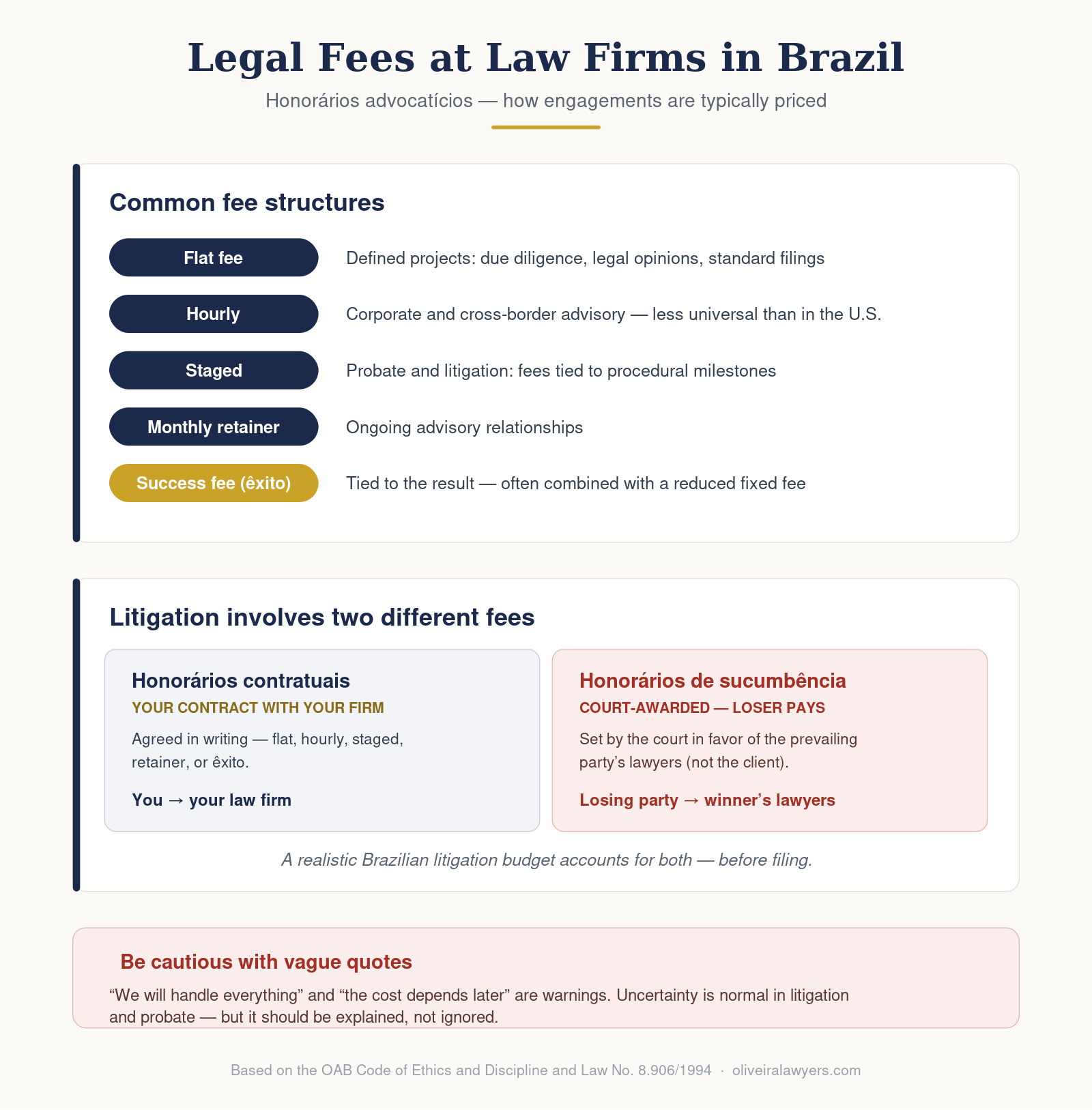
Brazilian legal fees are commonly called honorários advocatícios. They may be structured as flat fees, hourly fees, staged fees, monthly retainers, success fees, or mixed arrangements. A real estate due diligence matter may be easier to quote as a flat or staged fee. Litigation may require a combination of initial fees, monthly fees, hourly work, and success components. Corporate advisory work may be project-based or retainer-based. Probate may involve staged fees tied to procedural steps, estate value, or complexity.
The OAB Code of Ethics provides that professional fees and their payment conditions should be set out in a written contract, and it identifies several factors relevant to fee setting, including complexity, time required, the value and benefit involved, the nature of the work, location, professional competence, and customary practice.
Success fees also require care. The phrase contingency/success fee brazil is often used by foreign clients, but Brazilian practice does not always mirror U.S.-style contingency billing. Brazil recognizes fee structures tied to success in certain contexts, but those arrangements must comply with professional rules and should be clearly written. In Brazil, success-based fees are often referred to as honorários de êxito.
Litigation in Brazil may also involve honorários de sucumbência, often translated as court-awarded attorneys’ fees or losing-party fees. These are different from the contractual fees a client agrees to pay its own law firm. In many lawsuits, the losing party may be ordered to pay a percentage or amount set by the court in favor of the prevailing party’s counsel (meaning to the attorneys not the clients). For foreign clients, this is important because a litigation budget in Brazil should account not only for the firm’s agreed fees and court costs, but also for the possibility of court-awarded fees depending on the outcome of the case.
A good fee agreement should explain what work is included, what work is excluded, whether the fee is flat, hourly, staged, retainer-based, or success-based, how third-party costs are handled, whether taxes or government fees are included, what happens if the matter changes, and who is responsible for payment timing.
Foreign clients should be cautious with vague quotes such as “we will handle everything” or “the cost depends later” when the matter has significant consequences. Some uncertainty is unavoidable, especially in litigation or probate. But uncertainty should be explained, not ignored.
C. Frequently Asked Questions About Law Firms in Brazil
These are some of the most frequent clients’ questions based on our experience:
The Basics: How Brazilian Law Firms Work
1. How is a Brazilian law firm defined in Brazil?
A Brazilian law firm is a professional legal entity organized under Law No. 8.906/1994 and registered with a state section of the OAB (Order of Attorneys of Brazil), Brazil’s national bar. It may be a multi-partner sociedade de advogados or a single-lawyer sociedade individual de advocacia. Unlike ordinary companies, it cannot have non-lawyer owners, use a trade name, or run non-legal businesses.
2. How are law firms in Brazil regulated?
Law firms in Brazil are regulated by the OAB under the Estatuto da Advocacia and the OAB Code of Ethics and Discipline. The firm entity registers with the OAB Sectional Council where it is headquartered, every practicing lawyer holds an individual OAB registration, and the OAB exercises disciplinary authority over both.
3. What is the OAB, the Brazilian bar association?
The OAB (Ordem dos Advogados do Brasil) is the statutory body with exclusive authority over admission, regulation, and discipline of the legal profession in Brazil. Membership is mandatory: no one may practice Brazilian law or use the title advogado without OAB registration. It operates through a Federal Council and 27 state sections. See our own page about OAB here.
4. What is a sociedade de advogados?
A sociedade de advogados is the standard Brazilian multi-partner law firm: a professional partnership of OAB-registered lawyers that acquires legal personality by registering with the OAB Sectional Council, not the commercial registry. It cannot take corporate form, admit non-lawyer partners, or perform activities unrelated to legal practice.
5. What is a sociedade individual de advocacia?
It is the firm entity created by Law 13.247/2016 (the statute calls it sociedade unipessoal de advocacia) in which a single attorney holds the entire entity. It may have multiple attorneys and staff members employed and it follows the same rules as multi-partner firms: OAB registration, lawyer-name-based naming, exclusively legal activities, and unlimited subsidiary liability of the holder for professional damages.
6. Why are Brazilian law firms named after their partners?
Because the law requires it. Firm names must be formed from the names of current or deceased partners; fantasy and trade names are prohibited. A practical benefit for clients: the people legally responsible for the firm are visible in its name and traceable in public OAB registries.
Verification and Safety
7. How can I verify a law firm in Brazil from abroad?
Use two free public registries: the CNSA (cnsa.oab.org.br) to confirm the firm entity’s registration, and the CNA (cna.oab.org.br) to confirm the responsible lawyer’s active individual registration. Then confirm the verified name matches the engagement letter and the bank account receiving funds. Both databases are searchable from anywhere.
8. Can I check a Brazilian law firm’s disciplinary history?
Generally no. OAB disciplinary proceedings are confidential, and the public registries show registration status, not sanction history, unless a lawyer has been suspended or disbarred. That makes substitute diligence more important: longevity, a long-term record of positive Google reviews, directory presence, and the firm’s willingness to answer detailed questions.
9. What are the most common scams involving fake law firms in Brazil?
Typical patterns: invented “court fees” or “release taxes” on a supposed inheritance or unclaimed asset; fake official-looking seals and government letters; free email accounts instead of a firm domain; pressure to wire funds quickly, often to personal or non-Brazilian accounts; and guaranteed results. Each fails the registry-and-account-matching checks above.
10. Do legitimate Brazilian law firms guarantee results?
No. OAB ethics rules prohibit promising outcomes, and no honest firm guarantees what a court, registry, or authority will decide. A firm should instead explain realistic scenarios, probabilities where assessable, and risks. A guaranteed result is a red flag, not a selling point.
Foreign and International Law Firms
11. Can foreign law firms practice Brazilian law?
No. Under OAB Provimento 91/2000, foreign lawyers and foreign-firm entities may obtain authorization only as consultants on the law of their home jurisdiction. They are expressly prohibited from advising on Brazilian law or appearing in Brazilian courts, even with Brazilian lawyers assisting. Brazilian-law work is always done by Brazilian-registered professionals.
12. Can a U.S. lawyer practice in Brazil?
Not on a U.S. license alone. With OAB authorization, a U.S. lawyer may act as a foreign legal consultant limited to U.S.-law advice. Practicing Brazilian law requires the same path as for Brazilians: a recognized law degree and approval in the OAB bar examination.
13. What is a foreign legal consultant in Brazil?
A foreign-admitted lawyer authorized by the OAB to advise in Brazil exclusively on the law of their country or state of origin. The authorization is revocable, renewable every three years, requires reciprocity for Brazilian lawyers abroad, and prohibits Brazilian-law advice, judicial representation, and partnership with Brazilian advogados.
Working with a Brazilian Law Firm from Abroad
14. Do I need to travel to Brazil to work with a Brazilian law firm?
Usually not. Most matters proceed remotely through consultations, secure document exchange, and a properly executed power of attorney. Some acts still require original documents or in-person execution; an experienced cross-border firm identifies those at the start so travel, if any, is planned rather than improvised.
15. How do I hire a law firm in Brazil from abroad, step by step?
A typical sequence may involve: initial consultation; verify the firm in the CNSA and CNA registries; conflict check; written scope and fee proposal in a language you fully understand; signed engagement letter; payment to the firm’s verified Brazilian account; then document collection and defined first steps with a reporting cadence.
16. Will I need a power of attorney for Brazil?
For most remote matters, yes. A power of attorney for use in Brazil must be drafted for the specific acts intended, signed with the right formalities, then typically notarized, apostilled, and sworn-translated. Acts requiring a public deed need a POA in equivalent public form. Generic downloaded forms are a leading cause of delay.
17. Do my foreign documents need an apostille and sworn translation?
Generally yes. Public documents issued in Hague Convention countries need an apostille (Brazil joined in 2016); documents from non-member countries need consular legalization. Most then require sworn translation into Portuguese by a Brazil-commissioned public translator — ordinary certified translations from abroad are usually not accepted — and often registration with a cartório.
18. Can a law firm in Brazil work entirely in English?
Some can. An English-speaking law firm in Brazil should provide engagement letters, explanations, and reporting in English — but filings, deeds, and registry documents will be in Portuguese, as the law requires. The firm’s job is to bridge the two reliably, including on video calls, not only in writing.
Legal Fees and Costs
19. How do legal fees work at law firms in Brazil?
Professional fees (honorários advocatícios) may be flat, hourly, staged by procedural milestone, retainer-based, success-based, or combined. The OAB Code of Ethics directs that fees be set out in a written contract specifying scope, amounts, and payment terms. Third-party costs are always separate from professional fees.
20. Do Brazilian law firms charge hourly or flat fees?
Both exist, but hourly billing dominates less than in the U.S. Flat and staged fees are common for definable work — due diligence, opinions, probate phases — while hourly billing appears more in corporate and cross-border advisory. If budget predictability matters, ask whether your matter can be quoted as a fixed fee.
21. What is an êxito or success fee in Brazil?
Honorários de êxito are fees contingent on the result, often combined with a reduced fixed fee. They are permitted but regulated: under OAB ethics rules, success-based fees must be expressed in money and, together with court-awarded fees, cannot exceed the benefit obtained for the client.
22. Does Brazil have no-win-no-fee contingency arrangements?
Pure U.S.-style contingency is extremely rare in Brazil. Result-based structures exist but typically combine a modest fixed or staged fee with an êxito component, and they must comply with OAB limits. Be cautious with anyone offering aggressive no-win-no-fee terms on a matter they have not yet analyzed.
23. What are honorários de sucumbência?
Court-awarded fees under Brazil’s loser-pays rule: the losing party pays fees — generally 10% to 20% of the value at stake — set by the court in favor of the prevailing party’s lawyers. They are separate from what you agreed to pay your own firm, and they cut both ways: budget for the exposure before filing suit.
Matters and Timelines
24. Do I need a law firm in Brazil to buy property?
Brazilian law does not require a buyer to retain counsel — the cartório formalizes the deed — but the cartório does not protect the buyer. Title due diligence, seller checks, lien searches, contract review, and a safe closing structure are the buyer’s responsibility, which is why foreign buyers typically engage a law firm before signing anything.
25. Do I need a law firm in Brazil for an inheritance?
Yes. Brazilian law requires a lawyer in probate proceedings — including the faster extrajudicial (notarial) route. A foreign heir will also typically need document apostille and sworn translation, a Brazilian tax number, and often a power of attorney, all of which the firm coordinates from abroad.
26. How long do legal matters take in Brazil?
Longer than most foreign clients expect. Uncontested probates and registrations may conclude in months; litigation commonly runs years through appeals; disputed probates can exceed a decade. A serious firm gives you a realistic range — best case, typical, worst case — before you commit, rather than promising speed.
Privacy, Confidentiality, and Private Clients
27. Are court cases in Brazil public?
By default, yes — Brazilian dockets are largely electronic and publicly searchable, including party names. Family-law matters run under automatic judicial secrecy (segredo de justiça), and courts may grant secrecy in other cases on justified request. If discretion matters to you, raise it with the firm before anything is filed.
28. Are my communications with a Brazilian law firm confidential?
Yes. Brazilian lawyers owe a strict duty of professional secrecy (sigilo profissional) under the Estatuto da Advocacia and the OAB Code of Ethics, and client data is further protected by Brazil’s data-protection law (LGPD). Correspondingly, be wary of any firm that volunteers other clients’ details to win your business.
29. What happens to my matter if my lawyer retires or the firm closes?
A fair question for engagements that may run years. Ask how files are stored and transferred, whether other lawyers are familiar with the matter, and what continuity arrangements exist. Well-run firms have an answer in writing; long matters like probate deserve a succession plan for the engagement itself.
For Corporate Counsel and Foreign Attorneys
30. Do Brazilian law firms carry professional liability insurance?
It is not mandatory in Brazil, and coverage varies widely. The statutory backstop is personal: partners answer subsidiarily and without limit for professional damages. Institutional clients should ask directly whether the firm carries E&O coverage, with what limits, and reflect the answer in the engagement terms.
31. Will a Brazilian law firm work under our outside counsel guidelines?
Many cross-border firms will; many domestic-first firms have never seen OCGs. Ask early about conflict-check procedures, billing-guideline compliance, e-billing capability, matter budgets, and English reporting formats. The speed and quality of the answer is itself diagnostic of how the engagement will run.
32. Can a Brazilian law firm help with service of process or evidence for foreign litigation?
Yes. Brazil participates in the Hague Service and Evidence Conventions, with letters rogatory through the Superior Court of Justice (STJ) for what falls outside them. Note that taking depositions on Brazilian soil outside judicial channels is generally impermissible — experienced local counsel routes evidence-gathering through the lawful mechanisms.
33. Can a foreign judgment be enforced in Brazil?
Yes, after recognition. Foreign judgments obtained in the US or any other country require homologação by the STJ before enforcement in Brazil, subject to formal requirements including proper service and finality. Foreign arbitral awards travel under the New York Convention. Ask prospective counsel specifically about their recognition-proceeding experience — it is a specialized practice.
34. Can a Brazilian law firm provide expert declarations on Brazilian law for foreign courts?
Some can — it is a distinct skill. U.S. proceedings prove foreign law through expert declarations (FRCP 44.1), which demand precise English legal drafting and familiarity with U.S. evidentiary expectations. Vet this separately: ask about prior declarations, prior testimony, and sample formats before relying on a firm for expert work.
35. Is Oliveira Lawyers a Brazilian law firm?
Yes. Oliveira Lawyers is the website for Navas Oliveira Advogados, registered with the São Paulo section of the Brazilian Bar Association as . The firm focuses on foreign clients and cross-border matters connected to Brazil.
Need a Law Firm in Brazil?
We Can Help
[email protected]
(214) 432-8100
+55-21-2018-1225
#1 Contact us to get a free quote, or
#2 Schedule a Consultation now.